Showing posts with label Bathgate ND. Show all posts

Monday, December 21, 2015

On The Road to Bathgate Act 4i: Aunt Charlotte Nancy Foster Von Alman on Fire

Charlotte Foster and Arnold Leroy Von Alman,
Glendive, Montana, wedding photo, March 29, 1930.
We have relied on Charlotte Nancy Foster Von Alman's writing and storytelling many times. But up to now we have not written a post featuring aunt Charlotte. We rectify that here with additional passages from her family history and vignettes on her long and well-lived life.

Charlotte Nancy Foster Von Alman was born in Bathgate, North Dakota (population 43, 2010 census), November 22, 1906, the tenth of eleven children of I. J. and Laura Elizabeth Armstrong Foster. Charlotte was immediately preceded in birth by her brother Jimmy who was born on September 16, 1905. My father, George W. Foster, the eleventh and final surviving child, came into this world almost three years after Charlotte on August 27, 1909. 

After growing up in Bathgate Charlotte left to attend college, earn her teaching certificate and become a teacher in country schools in North Dakota and Montana. She married Arnold Leroy "Roy" Von Alman in Glendive, Montana on March 29, 1930. The newlyweds returned east to Littlefork, Minnesota shortly thereafter, where their offspring, Bob, Marge and Lyn, were born and raised. Marge lives in Littlefork to this day. Charlotte died at Littlefork on May 2, 1988. 


Foster family of Bathgate, North Dakota, 1910 Federal Census.

Charlotte Nancy Foster, December, 1906
Note the treadle (foot powered) sewing machine in the background of Charlotte's baby picture. As was typical in the day the machine was located near a window to permit entry of natural light to illuminate the sewing surface.

Charlotte bequeathed us fascinating snippets of family lore in the form of an 18-page, typewritten history on the Isaac Jarvis (1862-1934) and Laura Elizabeth Armstrong Foster (1870-1934) family. The history is jam packed with stories about Bathgate, her parents and ten siblings, and the life and times when the children grew up in Bathgate between 1890 and 1930. We sliced and diced, and then spliced the typewritten history into various Foster family ancestry posts, including on her sister Bina, her father Ike and mother Laura, her brothers Adams and Lyn, and her uncle George Sanderson Foster

Saturday, November 21, 2015

On the Road to Bathgate: Great-Great-Uncle George Pringle Sanderson -- Blacksmith, Locksmith and Safecracker, Part 3.

George Pringle Sanderson,
Councillor refers to his service
as an Edmonton alderman.
Welcome to Part 3 of our three part series on George Pringle Sanderson, 1850-1940. Part 1 focused on George's early years. Part 2 reviewed his blacksmith years. Here we recount reports of his locksmith career and the extraordinary tales that accompany it.

George was born in Eastern Canada and moved west across the Canadian prairies, ultimately to Edmonton, Alberta, nee North West territory. From 1878 into the early 1900's George's principal occupation was blacksmith. But with the proliferation of steam powered locomotion and massive growth in the use of internal combustion engines, demands for shod workhorses and oxen were waning. George turned to the locksmith profession to maintain body and soul.

Metalworking and fabrication skills learned at the forge facilitated George's transition into the locksmith trade. In the beginning George was more or less a traditional locksmith. He copied keys, serviced locking mechanisms, fabricated locks and hasps, reset tumblers and adjusted combinations. But his locksmithing skills evolved further with the proliferation of safes that ensued after the establishment of the province of Alberta in 1905.

George P. Sanderson was long-living proof of the adage about the man who builds a better mousetrap. Right up to his departure from this life in 1939, at any hour of night or day, Edmonton's finest would beat a path to George's door, seeking help opening a blaky safe -- or a safe whose owner was balky about opening. 
George said his talent was no secret; it was a gift, a special present from Santa Claus for being born on Christmas Day -- which occurred in 1850 at Carleton Place, Ontario.
We know, of course, that George Pringle Sanderson was actually born on Christmas Eve. But he wasn't the sort of a fellow to let a day or two get in the way of a good story -- and there are good stories aplenty about George and his safecracking escapades.

Sunday, November 15, 2015

On the Road to Bathgate: Great-Great-Uncle George Pringle Sanderson -- Blacksmith, Locksmith and Safecracker, Part 2

George Pringle Sanderson, 1850-1940.
Welcome to Part 2 of the three part series on George Pringle Sanderson. George was my great grandmother Margaret Sanderson Foster's (1840-1871) youngest brother. 

To summarize from Part 1:
George Sanderson was born December 24, 1850 in Carleton Place, Ontario. He moved to Winnipeg in 1877 to work as a blacksmith before moving further west, to Prince Albert, Saskatchewan by ox cart. He came to Edmonton in 1881 by buckboard. He became the settlement's second blacksmith and first locksmith. He returned temporarily to Winnipeg in 1883 to marry Julia Simpson, with whom he had four children.
Uncle George was a true pioneer. When he ventured across the Canadian prairies to Edmonton (established by Hudson Bay Company as Fort Edmonton, a trading post) the fledgling community's population was a couple of hundred residents, compared to near 900,000 today.

Edmonton's early days are celebrated in vignettes at reconstructed Fort Edmonton Park, which is operated much in the style of Colonial Williamsburg down in Tidewater Virginia.
One of Edmonton's premier attractions, the Park represents four distinct time periods, exploring Edmonton's development from a fur trade post in the vast Northwest, to a booming metropolitan centre after the First World War. The park features over 75 structures, many of which are the originals. Costumed interpreters operate the site and live the way of the past. Exploring each building, each room, and talking to the 'inhabitants' makes for an extremely enjoyable recreational visit. This attraction can be viewed in a few hours or may take many return visits to appreciate the sense of the past.
Blacksmiths were critical to the local economy in frontier Edmonton.
Before the horseless carriage age, the most essential persons in the community were the blacksmith and carriage maker. In their shops horses and oxen were shod, iron tires reset on wooden wheels, wagons and carriages made, and a great deal of wrought iron work such as hinges, hasps, and tools were fashioned. Today, the shops with their blazing forge, bellows and anvils, with the many tools, the noise and the smells would be a fascinating place.

An establishment in 1885 Edmonton combined both essential trades under one roof. George Sanderson and Edward Looby worked as partners for a number of years providing those services without which much of the community could not have survived. George P. Sanderson left Ontario in 1877 with the intention of settling in Winnipeg. After working four years as a blacksmith there, he and his friend and new partner Edward Looby, headed further west by ox cart. They arrived in Edmonton in October, 1881, and at once proceeded to set up a combined blacksmith and carriage making business.
We know George Pringle Sanderson had a blacksmith and carriage business. But what does that imply? Did he work out of a stall, a stable, a studio or something more? What was the scope of his business? What did it look like? How are we to know? Certainly no living person has personal recollection of George's enterprise, and stories passed along through oral family lore would suffer the ills of fading memory and fractured communication. 

But look see here, can you believe it? We got it! An 1883 photo of that very blacksmith shop, including mustachioed, towering George pictured out front wearing his leather work apron (affording protection from glowing hot iron rods and fiery embers) in the foreground. It will be recalled that uncle George's occupation was listed as joiner in the 1871 Census of Canada. In the construction of the shop, George obviously had put his carpentry skills to good work.

Title: George Sanderson's blacksmith shop, Edmonton, Alberta. Date: 1883
Remarks: Located at corner of Jasper Avenue and Namayo Avenue, (97th Street).

L-R: John Kelly, engineer and machinist; John Blair, carpenter; James Wright, printer at "Bulletin"; John Looby, blacksmith and partner, Sanderson and Looby; John Brown, on horse, merchant; George P. Sanderson; Charles Stewart, stage driver.

L-R on balcony: Mrs. G. P. Sanderson; Lizzie Kelly; Kat Kelly. John Brown's store, extreme left.
Subject(s): Edmonton, Alberta - Buildings / Log cabins and buildings / Edmonton, Alberta - Personalities / Blacksmiths and blacksmithing / Work clothes

Wednesday, November 11, 2015

We Salute Our Veterans

On this Veteran's Day, 2015, we solemnly salute all the military men and women who have served our country bravely and selflessly in the name of freedom, for there is no more precious commodity on this earth than liberty.

Today we single out for particular acknowledgement several of our forebearers who served in the United States Army during World War I, protecting us and our families and our allies from tyranny and aggression. 

The three men are Fosters of my father's generation, each of whom hailed from the tiny town of Bathgate, North Dakota, and sailed across the roiling waters of the North Atlantic to France, where they served on the blood stained battlefields on the Western Front. 

Let's start with uncle Lyndon R. Foster.
Fourth Infantry Division
Distinctive Unit Insignia
World War I was violently fought. Lyn was in the U.S. Army, Fourth Infantry Division, deployed to the western front, serving side-by-side with French and British troops. His division participated in the St. Mihiel offensive and the Muese Argonee offensives, phases 1 and 2. Elements of the division were gassed by German troops. The Fourth Division's authorized strength was 32,000. During World War I it suffered 2,611 killed in action, and 9,895 wounded. Records suggest that actual division strength was as little as 23,000 (13,000 regulars and 10,000 draftees) translating into a casualty rate of 54 percent, more than half of those who served.
Williston (N.D.) Graphic, February 15, 1917
Lyn enlisted on January 29, 1917 in Williston, North Dakota (currently the epicenter of the Bakken oil boom). He was sent to Jefferson Barracks, Missouri and served in Battery A, 16th field artillery to discharge. He was overseas from May 10, 1918 to March 24, 1919. Engagements were Aisne-Marne, St. Mihiel, Meuse Argonne and defensive sectors were Vesle (Champagne), Sommedieu (Lorraine). He was discharged at Camp Dodge, Iowa on April 16, 1919, as a private with a surgeon's certificate of disability, 15 percent. He was single at the time.

Lyndon's service, along with that of two of his cousins, was honored in the post-war publication "Pembina County North Dakota in the World War."  
Private Lyndon R. Foster.


4. Private LYNDEN (sic) R. FOSTER, Bathgate, son of Mr. and Mrs. I. J. Foster, born Sept. 26th 1897. Enlisted in the service Jan. 29th, 1917, and served with Battery A., 16th F. A., 4th Division, in France.


Corporal Robert S. Foster.

5. Corporal ROBERT S. FOSTER, Bathgate, son of Mr. and Mrs. W.K. Foster, born April 7th, 1895. Enlisted n the service Oct. 27th, 1917. Made Corporal Dec. 1st 1917, in Co. C., 164 Regiment, 41st Division, and served with them in France.


Corporal William C. Foster.


6. Corporal WM. C. FOSTER, Bathgate, son of Mr. and Mrs. W.K. Foster, born April 4th, 1899. Entered the service July 1st, 1915, and was made a Corporal July 10th 1917. Served in France with Co. C., 164th Infantry, 41st Division.

Lyndon was my father's brother. Robert and William were near neighbors and first cousins to dad and Lyndon (second cousins, once removed to myself). After deployment to France, their 164th Infantry Regiment (which was an activated unit of the North Dakota National Guard) was fragmented to serve up replacement personnel to other divisions, so the war record of individual soldiers in the unit is difficult to trace. 
The 164th Regiment lost 278 men in the war. One hundred seventy-six died in battle, 62 died of wounds, and the remainder succumbed to disease.
That's the simple history for the 164th. The thinly populated rural county of Pembina lost 32 men and women who served on behalf of God and country in World War I.

Uncle Lyn, cousins William and Robert, on behalf of all your descendants, thank you for your service to our country. We remember. We shall never forget.

Next year we shall honor an ancestor who fought in the Revolutionary War.

Following are supporting documents that surfaced in preparation of this post.

Documentation.


Pembina County North Dakota in the World War, from
North Dakota State University, Digital Horizons.


Robert Sanderson Foster's World War I Draft Registration Card.

The service records of these three young men were published in ROSTER of the Men and Women who served in the Army or Naval Service (including the Marine Corps) of the United States or its Allies from the STATE OF NORTH DAKOTA in the World War, 1917-1918. Following are those entries plus the cover and the dedication page. The book was published by their uncle R. D. Hoskins, who collaborated with the author and the Bismarck Tribune, which had the state printing contract.


Roster of the Men and Women who served in the Army or Naval Service (including the Marine Corps) of the United States or its Allies from the State of North Dakota in the World War, 1917-1918 Volume 2 Flagg to Lark

NameRobert Sanderson Foster 
Army #: 85,764
Registrant: yes, Pembina county
Birth Place: Bathgate, N. Dak.
Birth Date: 07 Apr 1895
Occupation: student
Comment: enlisted in Company C, 1st Infantry, North Dakota National Guard, at Grafton, on Aug. 27, 1917; served in Company C, 1st Infantry, North Dakota National Guard (Company C, 164th Infantry), to discharge. Grade: Corporal, Dec. 1, 1917; overseas from Dec. 15, 1917, to Feb. 26, 1919. Discharged at Camp Dodge, Iowa, on March 11, 1919, as a Corporal.


NameLyndon R. Foster
Army #: 564,651
Registrant: no, enlisted prior
Birth Place: Bathgate, N. Dak.
Birth Date: 26 Sep 1897
Parent's Origin: of Canadian-American parents
Occupation: plumber
Comment: enlisted at Williston on Jan. 29, 1917; sent to Jefferson Barracks, Mo.; served in Battery A, 16th Field Artillery, to discharge; overseas from May 10, 1918, to March 24, 1919. Engagements: Offensives: Aisne-Marne; St. Mihiel; Meuse-Argonne. Defensive Sectors: Vesle (Champagne); Sommedieu (Lorraine). Discharged at Camp Dodge, Iowa, on April 16, 1919, as a Private, Surgeon's Certificate of Disability, 15%.

NameWilliam Carrick Foster 
Army #: 85,751
Registrant: no, enlisted prior
Birth Place: Bathgate, N. Dak.
Birth Date: 04 Apr 1897
Parent's Origin: of American parents
Occupation: farmer
Comment: enlisted in Company C, 1st Infantry, North Dakota National Guard, at Grafton, on July 1, 1915; called into federal service on June 19, 1916, for Mexican border duty and served there until discharge; discharged from federal service at Fort Snelling, Minn., on Feb. 14, 1917, and resumed National Guard status; called into federal service, World War, on July 15, 1917; served in Company C, 1st Infantry, North Dakota National Guard (Company C, 164th Infantry), to discharge. Grade: Corporal, June 1, 1917; overseas from Dec. 15, 1917, to Feb. 26, 1919. Discharged at Camp Dodge. Iowa, on March 11, 1919, as a Corporal.


Bismarck Tribune, November 14, 1932.


Uncle Lyndon R. Foster's National Homes for Volunteer Disabled Veterans record.


Predecessor of the VA.

World War I dramatically increased the population of the National Home branches, though this new population had different needs.  The World War I veterans were primarily younger men who needed short term medical care or help with psychiatric problems. After World War I, women veterans entered the National Home branches in low numbers. 


Uncle Lyn spent two months recovering in the national home from March through May of 1922.

Friday, November 6, 2015

On the Road to Bathgate: Great-Great-Uncle George Pringle Sanderson -- Blacksmith, Locksmith and Safecracker, Part 1.

By blood on the paternal side of the family we are descendants of Fosters and Sandersons in my grandfather's line, and Armstrongs and Hollenbecks in my grandmother's line. Previously, I wrote multiple times at length about the Fosters, and posted several times about the Armstrongs (see the end of this post for a complete list of posts), but have reported little on the Sandersons and Hollenbecks. That is not for lack of material. Today's post begins to fill in the gaps via a look back at a notable ancestor in the Foster/Sanderson line. This is the first of three posts we will publish this fortnight on George Pringle Sanderson.

The Foster/Sanderson line has had quite a collection of Georges. My father was George (George W. Foster, 1909-1999). Dad had an uncle George (George Sanderson Foster, 1864-1946). Dad's uncle George also had an uncle George (George Pringle Sanderson, 1850-1940) who is the topic of this post. And that uncle George was the son of yet a fourth George (George Sanderson, 1808-1903). And oh, did I mention I have a first cousin named George?

The five generations of Georges had lengthy lifetimes, averaging eighty-nine years (excluding cousin George who is still with us near Reno in his eighties), collectively spanning the Napoleanic rule of Europe, Joseph Smith's founding of Mormonism, Marx and Engel's publication of the Communist Manifesto, the prosecution of the American Civil War, the inventions of the telephone (Bell), the phonograph (Edison) and the electric light bulb (Edison), the invention of the airship (Count Ferdinand von Zeppelin) and the airplane (Wright brothers), the invention of plastic (Baekeland), World War I, the rise and fall of the Third Reich (see Adolph Hitler), a worldwide Great Depression, the launching of man into space (Yuri Gagarin), near eradication of infectious diseases such as polio (Jonas Salk), smallpox and typhoid, and the invention of the internet (see Al Gore). Yep, they lived through a lot.

The third of the four Georges, George Pringle Sanderson, was born to George Sanderson and Mary Clark Sanderson at Kemptville, Ontario, Canada on 24 December 1850. He passed from this mortal world at Edmonton, Alberta on 27 October 1940. In between George Pringle Sanderson was carpenter, fire chief, alderman, blacksmith, carriage and bicycle maker, gunsmith, locksmith and safecracker. Here is his story.

Biographical Summary.

Most of the time when researching an ancestor, I have been fortunate to come across a summation already written that encapsulates his or her life. Often that is an obituary. Less commonly it is an article, a chapter, a passage in a book, or a synopsis that was written in consequence of that's relative's position or notoriety in life.  It was writings of the latter genre that jumped to the top of the search engine results when I researched George Pringle Sanderson. George's biographical sketch appeared straight away on the Project Gutenberg site.

GEORGE PRINGLE SANDERSON

George Pringle Sanderson.jpg
George Pringle Sanderson
Alderman on the Edmonton Town Council
In office
January 3, 1893 – January 2, 1894
In office
July 1896 – December 14, 1896
Personal details
BornDecember 24, 1850
Carleton Place, Ontario
DiedOctober 27, 1940 (aged 89)
EdmontonAlberta
Spouse(s)Julia Simpson (4 children)
ProfessionBlacksmith, locksmith

George Pringle Sanderson (December 24, 1850 – October 27, 1940)[1] was a politician in AlbertaCanada and a municipal councillor in Edmonton.

BIOGRAPHY

George Sanderson was born December 24, 1850 in Carleton Place, Ontario. He moved to Winnipeg in 1877 to work as a blacksmith before moving further west, to Prince Albert, Saskatchewan by ox cart. He came to Edmonton in 1881 by buckboard. He became the settlement's second blacksmith and first locksmith. He returned temporarily to Winnipeg in 1883 to marry Julia Simpson, with whom he had four children.
He became Edmonton's first fire chief in 1892, the same year as he ran in Edmonton's first election for town council. He failed to become alderman, finishing in a tie for eighth of fourteen candidates (the top six were elected). He was more successful in 1893, when he finished fifth of nine candidates, but was defeated in his 1894 re-election bid, finishing eighth of nine candidates.
In 1896, alderman Isaac Cowie resigned, and Sanderson was appointed by Council to take his place. He did not seek re-election in the next election. His last foray into public life took place in 1905, when he finished last of ten candidates in a bid to return as an alderman.
George Pringle Sanderson died in October 1940. He was buried on October 30, 1940.

REFERENCES


    Friday, July 3, 2015

    Uncle Lyndon King Armstrong At Rest

    Here at Along the Gradyent our blogging pace slowed considerably during June and into July. The primary cause? Our five-years young laptop started slowing down and sporadically freezing up, then self-checked into hospice and died, so the local PC repair geeks confirmed, leading to need for replacement. "No problem," we said. We went to the places that sold PCs in Bozeman, systemically checked out the machines and the interfaces to see what features could be had and how those features comported with our needs. We settled on the brand and style whose keyboard I am presently pounding.

    But we learned then that Bozeman is not a place where vendors actually stock computers. It could take from five to ten days to get a machine in hand after shipping from some distant West Coast distribution center, by which time we were preparing to leave town on our segment of a low-cost multi-family midsummer's journey of musical chairs' housesitting.

    "No problem," I said, "I don't need a computer immediately, I have a smart phone, that I can use that at least to search the net, navigate and receive and send emails," a bold claim which led sequentially, of course, to that four-year old hand-held devise's rapid demise. When we finally pulled up to a Best Buy in Seattle, the credit card lords hiccupped at the prospect of authorizing an expensive electronic purchase 687 miles from home.

    Anyhow, I shall spare readers the remaining details except to say that our blogging output will ramp up slowly as we learn a new system (since when did icons become charms?) and we enjoy the beauty and bounty of gorgeous summer weather.

    Now let's get to our presently intended blog post.

    About two-thirds of the way from Bozeman to Seattle lies the city of Spokane. Laying just west of the Idaho/Washington state line, Spokane's population rose from 350 in 1880 to about 20,000 in 1890. Spurred by a rapidly growing mining sector and following a boom pattern typical of the American West, the city's population skyrocketed to 100,000  by 1910. Spokane took these last 100 years to garner its second hundred thousand citizens.

    One of the 1890 migrants whose move into the city surged Spokane's population and drove its economy was my great uncle, Lyndon King Armstrong. Lyndon King Armstrong was a pharmacist, miner, engineer, publisher and trade association leader.  Lyndon set out from Bathgate, North Dakota, to the Pacific Northwest early in 1890.

    Monday, June 15, 2015

    On the Road to Bathgate: Great Uncle James Dyer Foster -- Teacher, Farmer, Assessor, Real Estate and Insurance Agent, and Agriculturalist

    Readers of this blog know we have posted a series of stories about my ancestors, including on what I call the family's greatest generation. We wrote in depth on my grandfather Issac J. Foster (1861 - 1934) -- real estate man, rancher, farmer, civic servant, insurance agent, auctioneer and county sheriff -- and his brother George Sanderson Foster (1864 - 1946) -- Chicago lawyer, owner and developer of real estate, Democratic politician and banker. Ike and George were the two eldest of five sons born to William K. and Margaret Sanderson Foster between 1861 and 1871. 

    My dad's first cousin, Etta Hoskins Meyer ,and her
    husband, Phillip Meyer, opened KFYR TV in Bismarck,
    North Dakota on December 19, 1953
    .
    We followed with posts about two of their brothers-in-law -- R. D. Hoskins (1860 - 1946), newspaper publisher and lawyer, first clerk of the North Dakota supreme court, and bookstore and florist proprietor, whose family went on to form a radio and TV media company in Bismarck, North Dakota, and Lyndon King Armstrong (1859 - 1942), pharmacist, engineer, miner and publisher of Spokane, Washington. Each of these men was worker, hustler, entrepreneur and pioneer to the core. Eash was a civic leader and dabbled in the political sphere.

    With this post we open a chapter on the fourth son (Isaac was the first and George was the second) of William K. and Margaret Sanderson Foster. James Dyer, known as J. D., moved to the western frontier like his brothers. But J. D.'s migration hewed north, staying above the 49th parallel and maintaining a Canadian branch of the family. J. D. had the family's characteristic drive and a multitude of skills and interests. He led a fascinating and productive life. J. D.'s contributions to his community and his province were many.

    Judge Jim Foster

    Around the time I launched this research and blogging enterprise a few years back I learned of the existence a living second cousin not previously known to me. His name is James (Jim) Foster, grandson of J. D. Foster. James Foster resides in Red Deer, Alberta, Canada. Jim had a distinguished judicial career. In this video clip from last year, Jim pushes for a new Red Deer courthouse. The locality's booming population (driven by a vibrant energy economy) and resulting legal wranglings have outgrown the built-in-1982 courthouse to the point that Red Deer traffic court is now being held Mondays and Tuesdays at the Red Deer Lodge hotel. I wonder if the judges have to check out of their chambers by noon?


    Lobbying for a new courthouse

    Red Deer Court
    Recently retired justice Jim Foster and Chris Rickards, president of the Central Alberta Bar Society say Red Deer needs a bigger courthouse. (Meghan Grant/CBC)
    To properly accommodate the population, Rickards says 16 courtrooms are needed, up from the now seven.
    He and recently retired Queens Bench justice Jim Foster are leading the push for a new courthouse.
    Foster served as attorney general under the Lougheed government and was a judge in Red Deer for more than 20 years. He says a new building has been needed for decades.
    "I understand that governments don't get around to building courthouses until there's a crisis …well, we're there and we've been there for a longtime."
    Foster said 40 per cent of his time as a judge was spent on family-related matters. He said it's children who suffer the most when those issues aren't dealt with for months at a time.
    "It's very damaging to children, these are little people, no voice and no vote and they're the ones most affected," explained Foster.  
    In another interview, Jim Foster projected that court congestion will cause delays that violate defendants' rights to a speedy trial.

    Saturday, April 11, 2015

    All The News That's Fit To Print?

    A 95 year old man who was a local legend died this week. Here is what the New York Times reported -- dismissive, cold, selective and gratuitous, no mention of his military honors or hint of the deceased's entrepreneurial spirit, hard work and individual successes  -- zero class. It's all about the blemish.
    Tim Babcock, a former governor of Montana who took office when his predecessor was killed in an airplane crash and who was later involved in an illegal financial scheme to help President Richard M. Nixon’s re-election, died on Tuesday in Helena, the state’s capital. He was 95.

    Chris Shipp, executive director of the state’s Republican Party, confirmed the death.

    Mr. Babcock was lieutenant governor when Gov. Donald G. Nutter, 46, and five others died in the crash of a twin-engine C-47 in mountainous timberland north of Helena on Jan. 25, 1962. The state’s agriculture commissioner and the governor’s executive secretary were among the dead.

    Mr. Babcock, a Republican, narrowly won election in 1964 before losing four years later to Forrest Anderson, a Democrat.

    After leaving the governor’s office in 1969, Mr. Babcock worked for the wealthy businessman Armand Hammer as a vice president at a subsidiary of Occidental Petroleum. He later got caught up in a campaign finance scheme linked to Mr. Hammer and Nixon’s re-election campaign in 1972.

    Mr. Babcock pleaded guilty in 1974 to concealing the source of a $54,000 contribution to Nixon. He was fined $1,000 and sentenced to four months in jail. The jail term was later set aside. President George Bush pardoned Mr. Hammer in 1989.

    Mr. Babcock had served three terms in the state’s House of Representatives before being elected lieutenant governor in 1960. His wife, the former Betty Lee, also a state legislator, helped write the Montana Constitution. She died in 2013. Republican stalwarts, they attended every Republican National Convention for 60 years.

    Mr. Babcock was born in Littlefork, Minn., on Oct. 27, 1919. A high school graduate, he served in the Army infantry in World War II. His survivors include a daughter, Lorna. Another daughter, Maria, died before him.

    Mr. Babcock later started a mining industry consulting firm, owned a hotel in Washington State and operated a cattle ranch in Wolf Creek, Mont.

    He often said he was the only Montana governor to take the oath of office with tears in his eyes, The Billings Gazette, a Montana newspaper, said in its obituary. Mr. Nutter had been a close friend.
    Here is what the Billings Montana Gazette reported on Mr. Babcock's passing.
    HELENA — Former Gov. Tim Babcock, who served as Montana’s chief executive from 1962-1969, died in Helena on Tuesday morning. He was 95.

    Funeral arrangements are pending at Anderson Stevenson Wilke Funeral Home in Helena.

    Although Babcock’s term as an elected official ended in early 1969, he and his late wife, Betty, remained the first couple of the Montana Republican Party for many decades after. They were regulars at state GOP conventions.

    He attended every Republican presidential nomination convention from 1952 to 2012 and was honored as the oldest delegate at the 2012 convention in Tampa, Fla.

    Babcock also was a prominent businessman. He and his wife built and operated what is now known as the Red Lion Colonial Hotel in Helena, and at one time owned a Helena television and radio station based in the hotel. The Babcocks later sold the hotel, but he kept an office there for decades afterward. They also owned a hotel in Spokane and the Ox Bow Ranch near Wolf Creek.

    Babcock also was involved as mining industry consultant and for years was the Montana representative of a company that planned to build an ethanol plant in Great Falls, which has not materialized.

    When a Republican was considering running for statewide office, the first step was to visit the former governor at the office to seek his advice and perhaps support.

    Tim Babcock was born Oct. 27, 1919, in Littlefork, Minn. His parents had moved there after losing their homestead at Crackerbox Creek in far Eastern Montana because they weren’t able to make the land payments. Six months later, his family moved back to Crackerbox Creek to farm the homestead for a friend who had bought it.

    He met Betty Lee when he was a senior in high school and she a sophomore at Dawson County High School in Glendive. He graduated in 1939. Betty Babcock graduated two years later, and they married in September 1941 when he was working at Douglas Aircraft in California.

    He worked at the aircraft plant until enlisting in the U.S. Army infantry in 1944. Babcock fought at the Battle of the Bulge and later received a Bronze Star for heroism at Remagen Bridge.

    After the war, Babcock returned to Glendive, he helped his father-in-law, Wood Lee, in his trucking business. One day, Lee asked Babcock if he wanted to become partners. Babcock said in his book that all the extra money he could contribute to the partnership was the $500 he had won gambling on the ship that brought soldiers home from Europe. That was good enough for Lee, and the trucking company took on the name Babcock & Lee Truck Lines.

    It expanded greatly over the years as the petroleum business grew in Montana.

    Babcock later became active in politics, winning a state House seat from Custer County in 1952. The Babcocks moved to Billings, and he was elected to the state House from there in 1956 and 1958.

    At the Legislature, Babcock became good friends with Donald Nutter, a state senator from Sidney.

    When Nutter was gearing up to run for governor in 1960, he asked Babcock to run as lieutenant governor. Prior to the 1972 Montana Constitution, candidates ran for the two offices separately, but Nutter and Babcock ran as a team.

    Nutter and Babcock both won their races handily.

    On the night of Jan. 25, 1962, Nutter was killed in an airplane crash during a blizzard near Wolf Creek, along with two top aides and three members of the Montana Air National Guard.
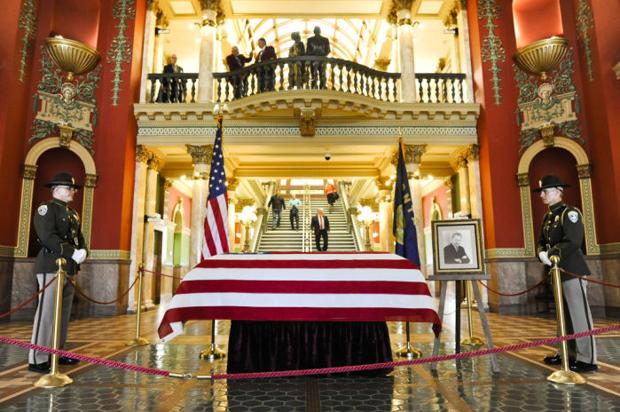
    Former Governor Tim Babcock, lying in state at the Montana state capital rotunda, April 10, 2015.
    Babcock said often he was the only Montana governor who had tears in his eyes when he was sworn into office.

    Babcock was a traditional Western Republican conservative governor who called for holding the line on government spending, limiting government’s role and developing natural resources. He criticized President Lyndon Johnson’s Great Society, which created new government programs to fight poverty.

    Babcock led the promotion of Montana’s Territorial Centennial in 1964, including backing a Centennial Train that traveled to the New York World’s Fair.

    In 1964, Babcock retained the governor’s office, narrowly defeating the Democratic nominee Roland Renne.

    Two years later, Babcock lost a bid to unseat Democratic U.S. Sen. Lee Metcalf, with Metcalf winning, 53 percent to 47 percent.

    In 1968, Babcock lost his race for re-election as governor. Attorney General Forrest H. Anderson, a Democrat, defeated him, 54 percent to 42 percent.

    Babcock’s support of a 3 percent statewide sales tax was a major issue in 1968. Anderson opposed the sales tax, running on the slogan: “Pay more? What for!”

    When Richard Nixon, a longtime friend, was elected president in 1968, Babcock had hoped to be appointed secretary of the Interior. Nixon appointed someone else.

    Instead, Babcock was recruited by wealthy oilman Armand Hammer, to be executive vice president of Occidental Petroleum subsidiary in Washington, D.C. It was a move Babcock came to regret, later calling Hammer a “scoundrel” and “schemer” in his book.

    During the Watergate investigations, Babcock pleaded guilty to making illegal political donations totaling $54,000 to Nixon’s 1972 re-election campaign in the names of himself and others. The money had come from Hammer.

    Babcock was sentenced to four months in federal prison and fined $1,000. But the federal judge refused to send Babcock to prison, saying he was Hammer’s “leg man” and noting that another judge let Hammer off with only probation and a fine.

    Betty Babcock died at age 91 in August 2013. She had a political career in her own right, winning election as a delegate to the 1972 Montana Constitutional Convention and the Montana House in 1974.

    The Babcocks had two daughters, Lorna and Marla, who is now deceased, and grandchildren and great-grandchildren.
    My aunts Charlotte (left) and Margaret
    (right),Winnepeg, Manitoba, circa 1930.
    For comparison purposes you may wish to note that the Times did not mention Teddy Kennedy was a Democrat until the 12th paragraph of his obituary, and buried his taking Mary Jo Kopechne's life in the 20th, not even meriting a complete sentence.

    My Aunt Charlotte Foster Von Alman (author of the family history that has turned up in many of my Bathgate posts) taught Tim Babcock -- in the second grade if my memory serves me right. She married her husband Roy in Glendive, Montana (pop. 4,935), and moved by 1930 to Littlefork, Minnesota (pop. 643), reversing the course of Governor Babcock's odyssey. May Tim Babcock, along with his wife, and my aunt Charlotte, rest peacefully and eternally. God bless.


    Wednesday, March 18, 2015

    Isaac J. Foster and Laura Elizabeth Armstrong Wedding Announcement

    We were delighted to find the other day this one hundred and fifteen year old wedding announcement, noting my grandparents' nuptials.
    Pembina Pioneer Express, June 6, 1890
    Foster – Armstrong – At the residence of the bride’s sister, Mrs. R. D. Hoskins, by Rev. John Scott, of Walhalla, on Thursday evening, May 28th, 1890, Isaac J. Foster to Miss L. Elizabeth Armstrong, both of Bathgate, N. D.
    The bride and groom are so well known to our citizens that to say that they have the well wishes of all, is unnecessary, as neither of them have an enemy who would wish them ill. The wedding was a quiet one, owing to the illness of the bride’s mother, Mrs. J. A. Armstrong, but a very pleasant one to those in attendance. May they enjoy a long life and prosperity, is the wish of all. They have gone housekeeping in the R. D. Hoskins house, which Ike has bought. – Bathgate Democrat. 

    My aunt Laura Albina Foster was born later that year, which would seem to explain the timing of the wedding and pressing ahead despite my great grandmother's illness. Ten more children would be born to the union, including my father, George W. Foster, the eleventh and final in the brood.

    It will be recalled that the Hoskins had moved on to Bismarck early that year, where R. D. Hoskins had been named the first clerk of the state supreme court on North Dakota's attaining statehood.

    The Pembina Pioneer Express had gone on line this last year after we had written a series of posts on Ike Foster. We look forward to using the newspaper as an especially valuable resource when we write going forward. 

    The Pioneer Express was the newspaper of record for Pembina county and reported on many of Ike Foster's doings in the then county seat, whether they involved his tenure as country sheriff, his raising of crops or involvement in animal husbandry, his land sales business or his incredibly active auction business. The latter three topics we have yet to write on.

    The Express fills important gaps from the fifteen year period when editions of the local Bathgate paper are missing from the North Dakota State Historical Society archives. Perhaps more importantly, the editor of the Express had a sense of humor and an editorial eye for Ike's style and personality that make him come to life in ways that are only hinted at in other sources we have come across. This should be fun.