Showing posts with label Golf. Show all posts

Sunday, February 21, 2016

What's in a Name?

So Bubba Watson won the Glenn Campbell Los Angeles Open, uh, er, I mean the Northern Trust Open today. Way to go Bubba!

The PGA Tour is finishing a swing that headed down, up and then back down the California coast this last month (with a detour to Arizona), finishing at Riviera Country Club in LaLa land for the Northern Trust Open. The tournament's title and sponsorship are contracted and paid for by the eponymous international financial services company. Northern Trust provides private banking, investment banking and wealth management services. Its customers don't get a free toaster with a new checking account, but many do get access to a catered suite with bar overlooking the eighteenth green.


Andy Williams San Diego Open logo hat.
Times change. So do names. A few weeks back, when I tuned into the Farmers Insurance Open broadcast on the Golf Channel, I thought oh yeah, the Andy Williams San Diego Open. 

Last week the PGA tour's traveling road show moved up the the coast to the AT&T Pebble Beach Pro Am, which once was the Bing Crosby National Pro-Amateur.  

The dropped tournament names harken back to a time when most early season PGA Tour events generated exposure and borrowed cachet by trading on the name, likeness, and talent of well known celebrities. 

Andy Williams was best known for his signature song, Moon River.


Williams jumped on to the sponsorship carousel when Tour events seeking promotional appeal and new revenue streams began taking on names that identified more than place.
The San Diego Open was founded in 1952, but hop-scotched around southern California for its first 16 years, never really finding a home. Williams came aboard in 1968 -- the same year that the tournament moved to Torrey Pines, and the combination of celebrity clout and first-class venue proved to be a real game-changer. The event has remained at Torrey ever since, and become one of the most successful on the PGA Tour – and no doubt that success helped to pave the way for Torrey to be awarded the 2008 U.S. Open, won by Tiger Woods in his memorable 18-hole playoff over Rocco Mediate.

Often there was a pro-am component to the celebrity named tour events. Celebrity pals, as well as accomplished athletes and notable politicians participated. Their star power drew attention and status, drove attendance, and attracted advertising and sponsorship dollars. 


1947 Bing Crosby National Pro Amateur program.
The granddaddy of them all was the Bing Crosby Pro-Amateur held in January/February on three courses on the Monterey Peninsula (in the oft-quoted words of Robert Louis Stevenson,  "the most felicitous meeting of land and sea in existence.").  
Crosby always had the Hollywood A-list stars like Jack Lemon, Dean Martin, Clint EastwoodPaul NewmanJack Nicholson, and recent stars like Bill MurrayGlenn FreyKevin Costner, Steve YoungGeorge LopezTom BradyTony Romo and Carson Daly all make the trip to Pebble beach for the Clambake.
In recent years you can add Justin Timberlake, Alice Cooper, Kenny G, Condoleezza Rice, Ray Romano, Larry The Cable Guy and Wayne Gretzky to that list.

Wednesday, February 10, 2016

Bridger Creek Golf

Bozeman got some play on the Golf Channel today when Bridger Creek's senior golf instruction program was featured on the Morning Drive program. Launch the video to see some of the background scenery that we are forced to play against in these parts. Eat your hearts out!


Sunday, January 31, 2016

What a Difference a Year Makes

Last year we played golf in Bozeman on February 5. That's not going to happen in this supremely normal winter of 2015-16.

Web Cam view from the clubhouse, across the putting green to the cottonwoods at the first tee, Cottonwood Hills Golf Course, Bozeman, Montana, January 31, 2016, 5:00 pm MST.


Tuesday, September 15, 2015

George Boznos and Sons: The Founding and Operation of Fabled Par King Skill Golf in Morton Grove, Illinois


When we grew up in Morton Grove Illinois during the late 1950s and through the 1960s, nothing represented the grandeur and the muscular vitality of the city of Chicago more than the Prudential building. Whether we were motoring along Lake Shore Drive or driving down to the Loop via the Northwest Expressway (as the Kennedy was initially known), we would gaze up and see the broad shouldered limestone edifice standing proudly above all. 
1950's view of the Prudential building, Chicago, from the lakefront.
Broadcast News Magazine, Vol. 112,
December, 1961
Back in the day WGN TV transmitted its signal over the airwaves from an antenna on top of the Prudential building. The antenna plus its supporting tower on top of the building rose a combined total of 914 feet above ground level, making it the tallest structure by far in the City of Chicago. 
The Prudential has a storied history. For two decades, from 1934 onward, through Depression and War, construction in Chicago had ground to a half. The skyline whose towers had popped up like weeds in the 1920's became frozen in time.

With an easement to build a trestle and breakwater a short distance from shore, the Illinois Central Railroad had controlled Chicago's lakefront since the 1850's. 
From the bank of the river southward, the IC had created a massive railyard, dominated by a huge sign for Pabst beer that as it met Michigan Avenue to the east was the most ambitious bit of construction on the site.

The Prudential Building would change all of that, When it was announced in 1951, it became the first structure to be built over Illinois Central air rights, and the opening shot in the revival of major new office construction. It included new viaducts along its perimeter, and a completely new street, the one-block Stetson Avenue, named after Edward Stetson, an I.C. board president. According to a post on the Connecting the Windy City blog, the air rights deed was 85 pages long and identified 500 small, individual pieces of property.

At 42 stories and 601 feet, the Prudential would fall just four feet short of overtaking the Board of Trade as Chicago's tallest building. Designed by Naess and Murphy, it broke ground on August 12, 1952. At nearly 22 million cubic feet, it was the fifth larger building in the city. Each of its 2,617 windows were double-glazed, and designed to allow both sides to be washed from the inside.

The Prudential was a compendium of superlatives. At 1,400 feet-per-minute, it's elevators were the world's fastest, and popping ears became standard elevator car conversation for first-time visitors. The Prudential had the biggest floor-to-floor heights. It's air conditioning capacity --  3,150 tons -- also set a record. Elevator service stopped at the 40th floor, and the world's tallest escalators carried visitors to the 41st floor and its observatory, which actually bested the one at the Board of Trade to become the tallest in Chicago. The panoramic views from Stouffer's Top of the Rock restaurant immediately made it a destination dining location for tourists and locals alike.
The Prudential building hole at Par King in Morton
Grove. A putt into the central elevator shaft went up
and over the top from where the ball would drop out
onto the rear green, tracking at or near the hole. 
A putt on either side would take an indirect route 
that made even a deuce difficult. 
It was a special treat for grade school students, Brownies or Cub Scouts on a field trip or families on a weekend excursion, to whoosh aboard the high speed elevators and climb up the sparkling escalators to the Prudential building's top floor, where they could experience the observation deck's uninterrupted vistas of Chicago to its borders and beyond. 

But we in Morton Grove did not need to travel 24 miles southeast to view the modern skyscraper. We had our very own Prudential building in the village on the grounds of the Par King Skill Golf course, where it stood out as a first among equals including scale-model replicas of national monuments like Mount Rushmore and the Statue of Liberty, and more whimsical icons such as the Old Lady Who Lived in a Shoe, The Three Bears and Humpty Dumpty. 

Sunday, August 23, 2015

Chick's Book -- An Autobiography By Charles Evans, Jr.

You don't need to travel to the Library of Congress to read it. It is online. It is complete. That is none other than the "Chick Evans Golf Book," immodestly subtitled "The Story of the Sporting Battles of the Greatest of all Amateur Golfers," written by Charles "Chick" Evans Jr., published in 1921. The book was written when Bobby Jones, now universally recognized as the most successful amateur golfer of all time, was still a young man and had yet to win the first of his 13 major championships.

The book confirms things we thought we knew about Chick -- he dearly loved his mom, and he thought the world of caddies and the caddie experience.

Chick paid tribute to his mom in the book's dedication.


He further recognized her prominent role by including her in the "Double Crown" photo of his cherished United States Amateur and United States Open golf trophies.


While more careful copy editing might have been in order (in the photo above, the trophies were said to be won in 1920, while the picture is copyrighted in 1917, the year after Chick won both championships), the book is a remarkable, contemporary insight into the life and times of a golf legend.

Thursday, April 30, 2015

Calvin Peete, 1943-2015

Here is to a man who lived the dash. I can't say it any better, so here is a tribute to and a remembrance of a man who overcame incredibly long odds to accomplish so much, and had not an immodest bone in his body.


Calvin Peete, 1943-2015: One of golf's least likely champions

Calvin Peete had an aversion to heat that was rooted in the summers of his youth and long hours picking corn and beans beneath Florida’s blistering sun. It left sweat stains on his soul that would not allow him even to keep a vegetable garden at home.
One day, friends invited him to play golf. “Who wants to chase a ball under the hot sun?” he asked rhetorically.
Peete, who died Wednesday morning at 71, was as unlikely a champion as golf ever produced. There was his upbringing; he was one of 19 kids from his father’s two marriages and was a high school dropout who worked in the fields “from sunup to sundown,” People magazine once wrote, “or, as he would say, from ‘can to cain’t.’” He had diamonds implanted in his two front teeth and sold jewelry to migrant farm workers. He did not take up golf until he was 23, and in a sport that preaches left arm straight, his was permanently bent from falling off a tree and breaking it.
Calvin.jpg
He not only took up golf, he became proficient at it, winning 12 tournaments, including the Players Championship in 1985. Eleven of those victories came from 1982 through 1986, more than any other player, and spent 20 weeks in the top 10 in the World Ranking. He won the Vardon Trophy for lowest scoring average in 1983. Jack Nicklaus was second. He also played on U.S. Ryder Cup teams in 1983 and 1985.
“Calvin was an inspiration to so many people,” PGA Tour Commissioner Tim Finchem said in a statement. “He started in the game relatively late in life but quickly became one of the tour’s best players, winning and winning often despite the hardship of his injured arm.”
His arm was crooked, but his forte was straight. For 10 consecutive years, from 1981 through his last full season in 1990, he led the PGA Tour in driving accuracy. In 1983, he hit 84.55 percent of the fairways. He also led the tour in greens in regulation on three occasions.
Peete was a quick study. Within six months of taking up golf, he was breaking 80. A year later, he was breaking par. He never took a lesson, but read instructional books by Hogan and Snead, Nicklaus and Toski. At the age of 32, he earned his PGA Tour membership.
“I can still remember watching Calvin hit drive after drive straight down the middle of the fairway, an amazing display of talent he possessed despite some of his physical limitations,” Finchem said. “Throughout his life, he gave so much, and we especially noticed it when he moved to Ponte Vedra Beach as he continued to support the community, the PGA Tour and our various charitable pursuits.
“Along with his wife, Pepper, he made such a difference working with the First Tee and junior golf in this area. Calvin will always be remembered as a great champion and an individual who consistently gave back to the game. We will dearly miss him.”
World Golf Hall of Fame take note. Honoring success is rooted in more than the number of majors a golfer wins. Rest in peace, Calvin Peete.


Sunday, April 5, 2015

The Masters (Repost)

Masters week is here. The golfing world’s attention is focused on the lush fairways, rolling hills, lightening fast greens and historic layout of Augusta National Golf Course, located in Augusta Georgia, just south of the South Carolina border. For those not in the know, The Masters is the first of golf’s four majors – the others being the United States Open, The (British) Open Championship and the PGA Championship. The course and tournament are progeny of golf legend Bobby Jones, who nursed them from infancy to become the most renowned in golf.
     
Augusta National 13th Hole
The Masters is about renewal and rebirth.  It is played in a setting adorned by flowering spring bulbs, blooming azaleas and dogwoods, stately magnolias growing along both sides of the clubhouse lane and towering pines paralleling the fairways. By virtue of its early season position the Masters first creates and then limits possibility. Only the winner of The Masters can achieve the most coveted (and never accomplished in modern times) feat in golf – coming home victorious in each of the season’s four majors -- the Grand Slam.

The Masters is link between young and old -- it's the youngest of the majors and the same time is most revered. 

For the old of it, two time Masters champion, Ben Crenshaw, is playing in his final tournament. Fred Couples always seem to find the elixir of youth at Augusta. Fifty-seven year old Bernhard Langer finished top ten last year, and is playing some of the best golf of his life.  

On the young end, twenty-five year old Rory McIlroy, ranked world number one, and twenty-one year old Jordan Spieth, currently the hottest player, are the betting favorites. McIlroy is looking for his third straight major victory and to complete his career Grand Slam. Spieth will be looking to impress his buddies, who will be graduating from UT Austin in a few weeks, with his first major victory. And watch for Patrick Reid.

Victor Dubuisson (France), Martin Kaymer (Germany), Sergio Garcia (Spain) and Justin Rose (England) are strong contenders all.

Suddenly, it seems in a blink of an eye, Ernie Els, Phil Mickelson and Tiger Woods, are on the downside of their careers. They are in Augusta too, hoping to catch lightening in a bottle.

Don't forget about Dustin Johnson.

Arnold Palmer, Jack Nicklaus and Gary Player
The Big Three in their Masters Green Jackets
The Masters bestows uniquely among the majors the honor of first teeing off Thursday morning to living legends. This year again the honorees are Jack Nicklaus (6 time Masters champion), Arnold Palmer (4 time champion) and Gary Player (3 time Masters champion). They once dominated professional golf as the Big Three. Decades later they are being honored for lifetime achievement and lasting contributions.  They have earned the privilege of driving the first tee shots into the morning dew.   

Byron Nelson, Gene Sarazen and Sam Snead
For almost two decades the honorary threesome had been Sam Snead (3 time Masters champion), Byron Nelson (2 time Masters champion) and Gene Sarazen (1935 Masters champion), gentlemen who legitimized professional golf in the post Bobby Jones era. Sadly, they are no longer with us, but we still have memories of Snead’s syrupy slamming swing, Nelson’s ruthlessly efficient stroke and Sarazen’s elan. Ken Venturi had the honors once.

Jock Hutchison and Fred McLeod
First Honorary Starters
The remaining two members of the exclusive honorary starters club are Jock Hutchison and Fred McLeod, who paired up from 1963 through 1973, which happens to intersect with the nine years I caddied at Glen View Club in Golf, IL. Why those two? Neither man won The Masters. But each did win another important tournament at Augusta. Bobby Jones was an organizer of the PGA championship for senior golfers, what today is called the Senior PGA Champrionship. And the first two Senior PGAs were played at Augusta National Golf Club. Hutchison won the first one in 1937, and McCleod won the second one in 1938. 

Jock Hutchison was a member and retired club pro at Glen View Club. I caddied for him from time to time when I was teenager. Looking the octogenarian up and down, I did not believe a word the old guy said when he pointed to a club in his bag and said “I won the Open Championship with this mashie niblick laddie.” Such is the ignorance of youth. But thanks to Jock I can say today that I caddied for a World Golf Hall of Famer, a one-time honorary starter at the Masters and a British Open and PGA champion. I can say that with confidence because now we have the Internet.

Gary Player, Jack Nicklaus and Arnold Palmer walk across Hogan's bridge on the 12th hole at Augusta National before last year's champions dinner at the Masters.

Newsreel on Jock Hutchison's 1921 Open Championship.


Good luck to all.

Thursday, April 2, 2015

Glen View Club -- Focus on the First Quarter Century, Part I

Blogging on the history of a country club -- how, you might ask, has it come to that? 

Let me explain it this way. I was channel surfing the other night and came across a C-SPAN Q&A interview with Erik Larson author of "Dead Wake: The Last Crossing of the Lusitania," just published on the 100th anniversary of the sinking of the ship. When asked why write on the Lusitania, Mr. Larson emphasized two things -- he was interested to learn more on the topic, and he found a treasure trove of original material (in his case at the Hoover Institute on the campus of Stanford University). 

Then, Erik Larson replayed video he shot out of a low lying porthole, framing the dark, roiling and seemingly limitless cold expanse of the North Atlantic. The Lusitania was sunk in those unforgiving waters on May 7, 1915, with a loss of 1,198 of the 1,959 on board.  Larson said he voyaged across the Atlantic because when it came to writing history he considered it essential to have visited "the scene of the crime." To have been there, even a hundred years later, gave him a sense of perspective and stark reality that helped the story come alive. 

For me, Glen View Club was a scene I visited more than a thousand time from 1964 through 1972. It is a ready made backdrop for a story. As for interest, the club was founded when United States golf in particular, and our country in general, were growing up. Glen View is a stage that was populated by key actors in those processes, people such as Angus S. Hibbard, a telecommunications pioneer, urban planner and architect Daniel Burnham, and Jock Hutchison, the first United States citizen to win the British Open championship.  By virtue of Glen View Club's notoriety and the stature of its members, plus resources like newspapers.com, choniclingamerica.loc.gov, archives.chicagotribune.com and books.google.com, treasure laden archives are there for the researching.

Mr. Allen satisfied an early need to stock Glen View
Club with polo ponies. Chicago Tribune, April 5, 1898.
So it is with this post and more to come, that we blog on the early history of Glen View Club in Golf, Illinois -- the club's formation, its early membership, and its design and development. Originally founded as Glen View Golf and Polo Club in 1897, Glen View has long been a retreat for rest, recreation and respite of social and business aristocracy up Chicago's North Shore. For me it was a place where I learned how to toil.

Glen View Club's membership has included prominent politicians and leading doctors and lawyers, as well as captains of finance, industry and commerce, with some intellectuals and a legendary golfer or two thrown in for good measure.
Noted members through the years have included U.S. Presidents, William Howard Taft and Warren G. Harding, Vice President Charles Gates Dawes, and renowned amateur golfer, Charles “Chick” Evans. Chick was joined in the World Golf Hall of Fame by Jock Hutchison, who served as Glen View Club’s head professional for 35 years.
I remember well caddying in the 1960s for octogenarians Chick Evans and Jock Hutchison, both major champions during Glen View Club's early years. I will write separately on each in due course.

Glen View revolves around outdoor recreation -- golf, tennis and swimming in the summer, and paddle tennis and trap/skeet shooting in the fall and winter. Early on the club hosted the most important tournaments in American golf.
In 1899, Glen View Club hosted the first Western Open – one of five to be held on our course. The Club hosted the 1902 U.S. Amateur, which was won by member, Louis N. James, the first American born golfer to claim the title. In 1904, Willie Anderson won the third of his four U.S. Opens at Glen View Club.
Glen View Club's female 
curlers  had a sense of humor.
Glen View once had a rustic indoor curling rink with parallel ice sheets, overseen by a mezzanine wet bar that saw more action than what unfolded on the pebbled ice surfaces below. When winter weather cooperates, the club grounds open to members and guests for ice skating, cross-country skiing and snow shoeing.

Tuesday, March 24, 2015

Another Day in Montana

A couple of guys didn't make it to work this morning.

On my way to golf past Four Corners, a little road rage, cars screech to a halt off the side of the road, drivers exit and engage in fisticuffs, shots fired ...

Subject vehicles pulled off into parking lot for fist fight and gun shots. We settle up our bets after golf in the Korner Bar & Cafe.
Here is the news report:

FOUR CORNERS - A road-rage incident escalated into a fight and gunfire this morning near Four Corners.
According to the Gallatin County Sheriff's Department, at 8:22 a.m. deputies responded to a report of a fight and gun shots in the parking lot of the Korner Club in Four Corners.
Initial reports indicated that a road rage incident involving two vehicles turned into a fight, followed by one man producing a gun and firing.
Deputies were on the scene quickly and the two men were detained.
One man was transported to Bozeman Deaconess for a cut above his eye from the fight - not the result of a gunshot.
Detectives are interviewing witnesses and investigating the scene to determine what charges will be filed.
Then at Cottonwood Hills the thermometer never cracked 40 and we were snowed out on the back nine -- just another day in Montana.


Friday, March 6, 2015

Rory McIlroy Hurls


When Roger Maltbie asked Rory's caddie on the next tee what club it was, he replied "A Nike."


Tuesday, March 3, 2015

Sunday, March 1, 2015

Newsreel: Jock Hutchison Wins Open Championship

Jock Hutchison, one of our loops from the days we caddied at Glen View Club, won the 1921 Open Championship on the Old Course at St. Andrews. Jock played with amateur Bobby Jones the first two rounds that year. Jones famously picked up and retired during the third round. 

We recently discovered this newsreel video documenting Hutchison's triumph. Jock is the short guy on the right.


British Pathe supplied the following caption.
Item title reads - U.S.A. Wins Open Golf Championship. "Jock" Hutchison - St. Andrews born, but playing for America, defeats Mr Roger Wethered in play off after thrilling tie. St. Andrews, Scotland.
Jock and Roger stand with their clubs and smile at the camera. M/S as Jock takes a shot. L/S of the course and players on the green. We see Jock being congratulated by the crowd, he takes his hat off and waves.
M/S of Jock and other men as they pose, he holds the winner's cup and pretends to drink out of it. C/U of Jock sat down holding the cup and smoking a cigarette.
Jock also won the PGA Championship in America (1920), as well as the National Open golf championship, which stood in for the U.S. Open in the war year of 1917. Cigarettes didn't strike Jock down. He was born in St. Andrews Scotland in 1884 and died 93 years later at Evanston, Illinois in 1977.

Signed photo of Bobby Jones, "For my old friend Jock Hutchison with all good wishes, Bob Jones."


Saturday, February 7, 2015

John and Bonnie: A Profile in Oil, Finance, Politics and High Society

I admit to being a skeptic and little impressed by power, position or authority.

In part, the ‘tude goes back to my days as a caddie. I learned the lesson young. I was the youngest at the caddie shack (a converted polo pony stable actually) the first time I caddied in 1964 at the ripe old age of ten. I continued caddying most every day each summer and weekends spring and fall, through 1971. I completed my caddie career after my first year of college in 1972, when I caddied summer weekends to supplement my weekday summer factory job earnings.


I caddied at Glen View Club in Golf Illinois, whose membership included well known doctors and lawyers, financiers, old money rich, merchandisers, bankers and many leading industrialists. It was an exclusive enclave imbued with tradition.The club's pedigree dates back to 1897. Glen View Club once hosted a U.S. Open golf championship. 

On the golf course, my loops (caddie slang for the people we caddied for) were taking a break from their business or professional lives. From a couple of feet, I would see them as they really were -- least so I thought. Do they play by the rules? Does my loop wallow in adversity or dig down deep to overcome it? Is the person focused or flighty? Fast or slow? Is the guy/gal sullen or sunny? Is he/she generous or stingy? Kind or mean? I saw these people as real human beings, exposing their full range of virtues and flaws, no matter how high or mighty might be their station in life.

I recall a particular Glen View Club member -- a gruff and reserved guy who had a paunch and wore wrinkled Bermuda shorts that exposed his pasty white legs. This guy was a woeful golfer who hacked the turf unmercifully and could not clear a water hazard to save his soul. He seemed incapable of improvement. I kind of wondered why he golfed at all. There was little joy and he was totally inept.


He sometimes played couples golf with his much younger wife. His wife was his opposite -- pretty, sunny and vivacious. She affected a Southern belle persona and syrupy accent – more than a bit melodramatically. On the golf course the wife wore short culottes and dressed colorfully and fashionably, her haired dyed golden blonde. She was a pistol. 

Her name was Bonnie. His name was John.

Friday, February 6, 2015

Cottonwood Hills Friday

I feel blessed they didn't capture my swing.

Thursday, February 5, 2015

I'll take that with a side of bacon and two eggs, over easy.

In golf news today, LPGA third-year tour player, and one time University of Alabama All American, Brooke Pancake, took a one shot lead in the first round of the Pure Silk Bahamas LPGA Classic, leading world number two, Inbee Park, and tour driving distance leader, Brittany Lincicome, by a single shot.

FULL LEADERBOARD

1
-6F-66767
T2
-5F-56868
T2
-5F-56868
T2-5F-56868
T5
-4F-46969
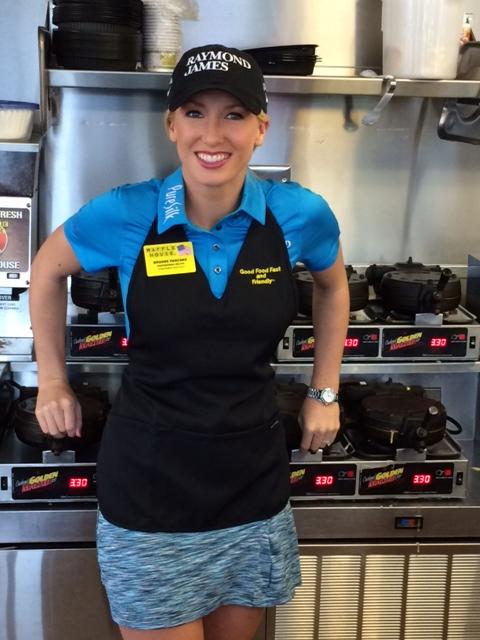
So what do you do if you are young, hot and your last name is Pancake? You team up with the Waffle House of course.
Brook Pancake at Waffle House
In a rather amusing twist, Brooke Pancake has announced Waffle House as her newest sponsor. Pancake, a former All-American at Alabama, will visit Waffle House restaurants throughout the country while traveling on the LPGA and carry the restaurant chain's logo on her bag.
“Growing up in Chattanooga, I’ve always been a Waffle House fan,” Pancake said in a release. “And to be quite honest, I prefer waffles over pancakes anyway.”
Pancake, now in her third year on the LPGA, married former UT-Chattanooga player Derek Rende one year ago but kept her maiden name. She will be serving waffle samples at the CHASE54 booth during the PGA Merchandise Show on Jan. 21 from 9-11 a.m. at the Orange County Convention Center in Orlando, Fla.
“This will be the first time that the Waffle Nation will be cheering for a Pancake,” said Walt Ehmer, Waffle House's president and chief executive officer. 
Pass the syrup, please.
The relationship was suggested by an executive of another breakfast icon.