Hi! Mrs. Grady here again, guest blogging. I hail from Texas -- born and bred in Odessa and raised in Huntsville. Studied at North Texas State and Sam Houston State universities, which explains this post, perhaps.
Texas has cactus. There are many stories and more than a little folklore about cactus: break
one open and eat it if you’re wandering in a desert without water, for example. Wait, don’t do that unless you are a botanist. Another is that cactus juice can help arthritis pain. Botany books devote lush photos and Latin terms regarding cacti
and their blooming habits. Hollywood glorifies the blossoms.
Cultivated Cactus Flowers
Personally, I think
you’d have to be crazy to cultivate cactus. However, the Cactus Viper margarita
at Zuni’s Grill on the Riverwalk in San Antonio (my favorite restaurant in the
world) may be the best reason to keep succulents on the menu. Well-behaved dogs
on leashes are allowed at Zuni’s, but leave your horse at home.
Some crazy person cultivated this cactus
at theZilker Botanical Garden in Austin, Texas. As if Texas doesn’t have enough cacti already. Head on over 31Aug-1 Sep for the Cactus and Succulent show.
Saturday, Aug 31, 10am to 5pmThe Austin Cactus and Succulent Society's Fall 2013 Show and Sale The 2-day event is free and open to the public with paid admission to ZBG. It is very popular with gardeners of all ages. The show offers visitors a chance to see rare and beautiful cacti and succulent species from around the world. Vendors from Texas, Oklahoma, and New Mexico will sell native and exotic cacti and succulents, and hand-made pottery at reasonable prices. There will be a daily silent auction and hourly plant raffle of rare and collectible cacti and succulents. Educational information, literature, and expert advice will be available. Come and bring a friend. For more information about the Austin Cactus & Succulent Society and its programs, please visit www.AustinCSS.com.
Zilker's Koi Pond
Buy
exotic and native cacti during the silent auction as well as learn about cactus
care. It’s is quite a highfalutin’ event! But there is no valet parking for
your horse. Why doesn’t their website have tons of
photos of their cactus auction? Hmm? I tell you what, this here photo of Zilker's Japanese koi pond sure don’t make me want to buy cactus. Now I’m in the mood
for sushi.
Barack Obama fashions himself more than a little bit in the image of Abraham Lincoln. Turns out Obama's knocking it right down Abe's path, by the numbers.
House Republicans have crunched the numbers and say that since President Obama took office, the economy has added seven times more part-time jobs than it has created full-time jobs.
Since January 2009 the country has added a net total of 270,000 full-time jobs, but it has added 1.9 million part-time jobs, according to the House Ways and Means Committee.
Abraham Lincoln was widely renowned for being the rail splitting president. Now Barack Obama is cementing his reputation as the job splitting president. Way to go Barack!
The bleeping alarm clock was beeping, on the concourse of Palm Beach International Airport no less, causing a major closure.
WEST PALM BEACH -- The suspicious bag caused two floors of Palm Beach International Airport to be evacuated and close for several hours, delaying flights.
Bleeping dog hunting down bleeping alarm clock.
David and Joshua Pierre-Louis were getting their great aunt’s IBC Air boarding pass for a noon flight to Haiti when police ordered them outside, along with everyone around them.
That was at about 11:30 a.m., the brothers said. They didn’t get back inside until almost 2 p.m.
I wish someone would do something about those suckers. I got one of those alarm clocks too -- goes off at 5:00 or 6:00 am on Sunday mornings. Time to put an end to it.
We've had the AC on maybe 3 or 4 days all summer. Overnight lows have been in the 40's the last three nights; four handle lows are forecast to continue 9 days out of the next 10. Meanwhile, it is positively frigid in the land of the supposedly disappearing ice pack.
Obama posturing during Georgetown speech
“Normally the high Arctic has about 90 days above freezing. This year there was less than half that,” says Steven Goddard website. “The Arctic ice extent is showing a remarkable recovery from the great oscillations of 2012,” says F. Guimaraes. “Compare with the previous years listed there, you’ll see that 2004 is the year that is closest to 2013 in terms of average temps during the summer.”
Meanwhile, at the other end of the earth, they are saying,
Antarctic Sea Ice Extent Breaking All Records. Antarctic sea ice extent at the end of July was the highest on record for that day, growing to 18.077 million sq km. The previous record of 17.783 was set in 2010, whilst the 1981-2010 average was 16.869. Ice extent has been above average all year, and, according to NSIDC, is outside the 2 Standard Deviation range now.
Alas the sheeple united know this can't be so because they saw Barack Obama extemporizing and mopping his un-sweated brow with white handkerchief on a day of relatively normal daytime temperatures in the urban heat island that über developed Georgetown has become in Washington, DC. Carry on true believers, carry on.
The storm pushed through Thursday evening. Winds blew 50 to 60 miles per hour. It produced 1 and one-half inch hail, and caused major crop and isolated property damage. We took the following shots as the storm encountered the 8,000 to 10,000 foot barrier of the Bridger Range ridge line. Just south of the the storm path, we could see the storm cell's meteorological progression with the naked eye.
Roiling across the Gallitan Valley to the Bridgers.
Storm movement left to right; notice downdraft is blowing trees hard opposite, right to left.
Clash of the storm with opposite wind cause swirling rotation.
Rotation attempts to form a vortex just before friction with the ridge line breaks it up. Notice at this point trees are upright.
If a young adult is unemployed or under employed, or is saddled with student debt, the easy solution is to live with mom and dad -- if you have them which, of course, most poor people don't. Reflecting economic conditions, it's a solution sought by an increasing large share of today's coming of age crowd. In the 16 to 19 year age group unemployment is 23.7 percent. For the 20 to 24 year old cohort the jobless rate is 12.6 percent. Total student loan debt is pushing $1 trillion dollars. Average student loan debt for graduating seniors is $26,600, with many students graduating with a debt load in excess of $50 K.
In 2012, 36% of the nation’s young adults ages 18 to 31—the so-called Millennial generation—were living in their parents’ home, according to a new Pew Research Center analysis of U.S. Census Bureau data. This is the highest share in at least four decades and represents a slow but steady increase over the 32% of their same-aged counterparts who were living at home prior to the Great Recession in 2007 and the 34% doing so when it officially ended in 2009.
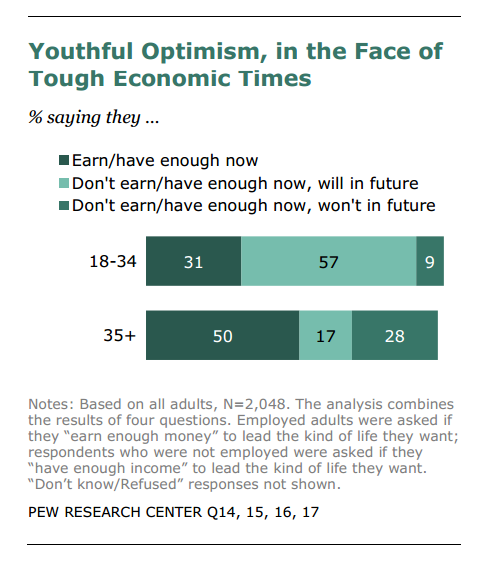
Here is a visual of the trends.
There have been sharp losses in employment opportunities for young adults in the Obama years with essentially no rebound post recession.
Despite this young adults are optimistic about their futures.
Much more so than their older compatriots who have had more experience with the crucible of time.
In February we called them "Phones for the Poor." In June we called them "Obamaphones." The result of the focus and publicity is, well, the so-called lifeline phones are as easy to fraudulently secure as ever. A National Review scribe in a single month "received three shiny new cell phones, courtesy of American taxpayers, that should never have fallen into [her] hands."
To be eligible for Lifeline, the applicant is supposed to be receiving some significant government benefit — food stamps, Medicaid, Supplemental Security Income, public housing assistance, etc. But because welfare eligibility has expanded under the Obama administration, more people than ever before are qualified to receive “free” cell-phone service — part of the reason why Lifeline mobiles have become commonly known as Obamaphones. Alternatively, applicants can qualify if their household income is less than 136 percent of the federal poverty line.
But as with any federal program with too much funding, too little oversight, and perverse financial incentives, Lifeline has become infamous for rampant fraud and abuse. There have been news reports about recipients flaunting dozens of subsidized phones. And in February, the Wall Street Journal reported on an FCC audit of the top five Lifeline providers, which found that “41% of their more than six million subscribers either couldn’t demonstrate their eligibility or didn’t respond to requests for certification.”
The FCC supposedly buckled down on eligibility standards last year and established other safeguards aimed at reducing fraud. I was curious about how tough it was to get one of these phones, so last month, I hit the streets of New York. And out of respect for the law and my journalistic integrity, I did not lie to obtain a phone.
Phone recipients sell their ill-gotten benefit to buy drugs, handbags, or whatever.
The free for all handout method is working so well that Dear President is applying it to Obamacare subsidies. God help us.
Like virtually every claim made with respect to the parade of the Sequester's horribles, civilian employee furlough days at the Pentagon and DOD installations nationwide were grossly exaggerated. The number of non-uniformed personnel furlough days for the fiscal year (ending September 30) started out at 22, dropped to 11 and now actually will be more like 6, according to the AP. One of the most absurd claims about the DOD belt tightening came early on from the Governor of Hawaii, carping about the sequestering impact on his locals.
The plain fact is, that will undermine our capacity for readiness at Pearl Harbor. And if that doesn't symbolize for the nation that, far from overstating anything, it is zeroing in on a graphic example of what happens when we fail to meet our responsibilities congressionally. You don't want to undermine that capacity to be able to respond.
We called it then and there a "phony alarm." As far as I can tell, there hasn't been a Japanese sneak attack. Maxine Watters said the sequester would "cost 175 million jobs." Education Secretary Arnie Duncan said 40,000 jobs would be lost in education alone. The White House said 13,000 people would be going down one way or another in Montana. Obama said first responders wouldn't be able to respond, teachers would lose their jobs, hundreds of thousands of people would not receive medical care, the US would lose its ability to respond to threats and hundreds of thousands of people would lose their jobs. The national parks wouldn't reopen in the spring because the roads would not be plowed. Lies, all lies, from the left to justify outrageous spending and passing along humongous debt to our children. Debbie Wasserman Schulz complained that lunch prices for hill staffers would go up a couple of bucks as food subsidies were withdrawn. She was right about that....awwwwww! Enough said.
I dropped a couple of letters from the name because the only way the Postal Service can survive to serve is trim its scope and hollow its core. While the American Postal Workers Union (APWU) blithely advertises the Postal Service doesn't cost you the taxpayer a single dime ....
This APWU TV ad aired on NBC, CNN, MSNBC and Fox beginning July 8.
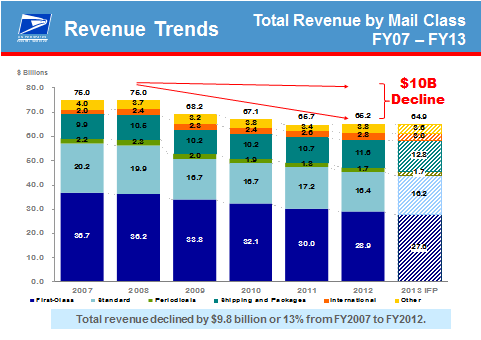
..... the Postal Service is broken and broke. The Postal Service ran up losses of $15.9 billion in 2012, $5.1 billion in 2011, and $8.5 billion in 2010. Through 2012 total Postal Service losses accumulated to $38 billion. If the Postal Service were put into bankruptcy today the process would be tasked with resolving debts twice the size of the mountain of debt Detroit brought into its bankruptcy filing. The Postal Service has been able to pay bills and remain a going concern for the last several years only because Congress has passed emergency, kick-the-can-down-the-road legislation, permitting the Postal Service to welsh on its payment into the Federal Treasury -- payments that fund Postal Service employee and retiree health care benefits, pensions and workers' compensation claims. With its diminishing revenue stream, the Postal Service will never be able to make these payments; thus the APWU claim of no taxpayer funding is a joke, or to use Barack Obama's terminology, phony.
The Postal is confronted with a permanently declining revenue trend.
The Postal Service's financial collapse isn't so much a question of mismanagement and inefficiency as it is a consequence of an outdated, sclerotic business model imposed on it by the Congress. That model worked, even thrived, during the first 30 years (1971-2001) of the Postal Service's existence as an independent (as in rate payer funded) agency when consistent economic growth, technological breakthroughs in database management and mail marketing, lifestyle changes, and deregulation and innovation in the financial, telecommunications and media sectors of the economy drove strong mail volume and revenue growth. But the mail volume growth curve weakened at the turn of the century, then stalled and stopped entering the Great Recession, when financially lucrative First-Class volumes plummeted, never to return. While the economy was the catalyst, the ultimate disposition of mail based transactions and messages was to the internet. Most of us, for most of that, don't need the mails anymore. For its long term survival and ability to serve, the Postal Service needs to wrest tens of billions of dollars out of its cost structure. The volume and revenue to support the Postal Service as we know it simply are no longer there. The Postal Service is in an all of the above kind of situation, the most important items of which are listed below.
Six day a week delivery must go. While 5-day delivery plans have been put on the table, ultimately there need only be 3. These days, anything that is so time-sensitive that you can't wait a day or two for it comes via email, express, or expedited delivery services. The every day, grind it out postal delivery model is needed no more.
Collection boxes are not the only
things that need to be surplussed.
Those who receive door delivery need to join the rest of us (most of the population) who receive our mail curbside or at some sort of centralized delivery receptacle. The labor intensity of door delivery is insupportable by declining postal revenues.
Thousands of small stations, branches and post offices need to go. While many of their patrons claim the social fabric of their community will be torn by closure, the real agenda mostly is to support keeping in their communities the very high paying jobs that the postal system can no longer afford.
Postal Service management needs to get new tools to negotiate agreements and compensation structures with postal labor. Currently, third party arbitrators are authorized to impose labor contracts on the postal system with little or no regard or economic consequence. One of the consequences of this extraordinary circumstance is large portions of the postal labor force are compensated significantly more than counterparts at FedEx and UPS. The resulting artificially high cost structure makes it impossible for the Postal Service to compete for most of the package delivery market, which costs the postal system revenue that could help support the Postal Service's infrastructure.
The Postal Service pension and post retirement health benefit systems and their funding must be reformed. While most of the public discussion on these issues has focused on funding mechanisms, the basic obligations are too expensive for the Postal Service to afford going forward. The postal unions exaggerate by a factor of two or three the annual savings that will result from legitimate pension and health benefit reform. Retirement programs are not the only problem, not by a long shot.
And yes, postal rates need to rise, for many services significantly. The big users of the postal system are big business -- big banks, big mail order companies, big telecommunication firms and big publishers. They have used their insider status and political influence to put restrictive and financially draining caps on postal rates. It's time for big business rate caps to come to an end. Otherwise our children and grandchildren will end up paying the bill through postal-sourced accretions to the burgeoning federal debt bomb.
There is much to do. Congress needs to get on with it.
Here in Montana we are part of the problem instead of part of the solution, thanks most obviously to Senator Jon Tester. Earlier this year Tester stood in the way of postal reform by invoking the constitutional right to mail delivery. Tester said, "It's in the Constitution that we have to have a Postal Service" which is, of course, an outright fabrication. This wasn't an off the cuff remark. Tester put it out in a press release. Tester's big idea for reducing the $10 billion gap is to get rid of a couple of part time members of the Postal Service's Board of Governors and to limit the Postmaster General's salary. This guy really believes his stuff.
Something has got to break, and for the sake of my children and grandchildren who otherwise will be paying today's outsize postal bills tomorrow, I would hope that what breaks is the Jon Tester, big labor and big mailer stranglehold on the outmoded and unsustainable, debt accumulating, postal business model. It is time to move truly forward.
An Oregon woman successfully sued Equifax for messing up her credit report. She was awarded $18.6 million in damages.
Miller's troubles began in 2009, according to her complaint, when she was denied credit from Huybbard Bank based on her Equifax credit report. She requested and eventually received a copy of her report, which, she discovered, contained false identifying information, an incorrect Social Security number, a false birthday and false, derogatory collection accounts attributed to her.
She began disputing these inaccuracies starting in 2010. She repeatedly contacted the company and was repeatedly told Equifax needed further information before it could process her dispute.
Later in 2010 Miller was denied credit by Key Bank, based on her Equifax report.
After filing further protests with Equifax about the inaccuracies in her report, Equifax representatives told Miller her data had become "mixed" with another person's. They told her she would need to dispute the false information directly to her creditors.
In all, Miller tried eight times to get her report corrected. Finally, she brought suit in Oregon Federal District Court in October 2011.
There is at least some justice in that corner of the world. Now if we could only sue the IRS.
Club Fed continues to spew riches. This comment on WAPO's blog says it so.
All that wealth and opulence – bought and paid for by the rest of the country, so our rulers can live in a style and fashion that the rest of us can only imagine. Is this a great country or what?
Sequester is a no-quester when it comes to housing and real estate in the federal government based economy in the Washington, DC area. Feds throughout continue to grow the financial divide with middle America as the real estate they occupy appreciates by leaps and bounds and federal largess makes housing affordable for contractors and employees.
Demand is soaring, but supply is not keeping up. The region’s supply of homes is the tightest it’s been since well before the financial crisis, according to recent data. The result? It takes only nine days for most homes to be snapped up by hungry Washington home buyers. The region’s entire inventory of homes for sale could be consumed in as little as two months.
This tight inventory is pushing up home prices, setting up bidding wars and pricing new home buyers out of a market that is still enjoying historically low mortgage rates. Homes in the $300,000 to $600,000 price range are selling the most quickly — usually in a week, according to June data — making the market particularly hard to navigate for first-time home buyers who want to live close to the District. Just a year ago, those homes sat around for at least three weeks.
Even homes at the higher end of the spectrum — from $600,000 to just shy of the $1 million mark — are on the market for eight days. On the other side of the scale, homes priced lower than $300,000 are available for just over two weeks.
Washington’s strong labor market and relative immunity from the housing crisis meant that demand never really dried up here, analysts say. But supply hasn’t kept pace.
Here are the numbers. It pays to be in Club Fed.
For all home types in the Washington area:
MEDIAN SALE PRICE
In thousands
$400,000
$400
300
200
100
0
2012
2013
J
J
A
S
O
N
D
J
F
M
A
M
J
ACTIVE LISTINGS
In thousands
10,374
10
8
6
4
2
0
8,281
2012
2013
J
J
A
S
O
N
D
J
F
M
A
M
J
MEDIAN DAYS ON THE MARKET
For all home types
June 2013
June 2012
Washington metro area
9
19
Alexandria
12
22
Arlington County
7
13
Fairfax County
7
14
Loudoun County
9
22
Montgomery County
11
25
Prince George‘s County
17
37
Prince William County
12
20
Washington, D.C.
9
17
SOURCE: RealEstate Business Intelligence. GRAPHIC: By Tobey - The Washington Post. Published July 24, 2013.
It's being implemented. We are learning what is in it now. Federal employees see Obamacare coming their way. They are ducking and heading for the hills.
In the private sector, many workers are concerned about losing their employer-sponsored health insurance coverage, and being dumped into Obamacare’s subsidized insurance exchanges. Two weeks ago, representatives of three large labor unions fired off a harsh letter to Democratic leaders in Congress, complaining that Obamacare would “shatter…our hard-earned health benefits” and create “nightmare scenarios” for their members. Today, we learn that the National Treasury Employees Union—the union that includes employees of the Internal Revenue Service—is asking its members to write letters to their Congressmen, stating that they are “very concerned” about legislative efforts requiring IRS and Treasury employees to enroll in the Obamacare exchanges.
“I am a federal employee and one of your constituents,” the letter begins. “I am very concerned about legislation that has been introduced by Congressman Dave Camp to push federal employees out of the Federal Employees Health Benefits Program (FEHBP) and into the insurance exchanges established under the Affordable Care Act (ACA).”
Oh my! Oh no! Club Fed is saying not for us, Obamacare has got to go.
Meanwhile, in the buy 'em by the bag land you can buy one, two or three sack fulls. It makes no difference. Pushed by Obamacare's implementation White Castle -- in sharp contrast to its current employee mix -- is driving towards a part time benefit free workforce. Currently,
White Castle employs around 9,600 workers nationwide and about half work full-time. Roughly 80 percent of White Castle's full-time employees opt in to the company's current health care plan and the company spends four to five times more in health care than it makes in net income annually, Richardson said.
Obama is all for the middle class. If you don't believe it, ask him. Remember his motto. Forward! Move on!
Whether you are enjoying the view or the refreshing feel of a cool mountain stream, casting for trout, or boating, tubing or rafting, Montana rivers and creeks are an awesome natural resource. But locals and visitors alike best be wary, lest they veer down an embankment, drive off the road, get pinned by or slip into the current, capsize or even unexpectedly encounter an otter. Drowning and hypothermia are ever present dangers. Now we can add to the long list of hazards -- a suddenly falling humanoid. It happened earlier this week in Missoula,
Clark Fork River Bridge, Missoula Montana
MISSOULA, Mont. (AP) — A western Montana man floating on an inner tube suffered broken bones in his legs and torn ligaments in his knees when another man jumped from a bridge and landed in his lap.
Andy Hill of Missoula and his wife were floating under a bridge on the Clark Fork River near East Missoula Sunday when the man landed on him, KECI-TV reported.
"Suddenly I had intense pain and was under water," Hill said.
"There was a guy on my lap and he rolled off my lap and he just kept apologizing saying 'I'm sorry, I'm sorry, I'm sorry,'" Hill said.
The man swam Hill to shore, still on the inner tube, and the man's friend helped Hill as well.
Hill suffered broken bones in both lower legs and a cracked femur in his left leg and will likely spend the rest of the summer in a wheelchair or on crutches.
But he's been able to keep his sense of humor.
"Who does this happen to?" asked Hill, laughing. "I don't know of anybody this has ever happened to."









.JPG)
.JPG)


