Tuesday, April 7, 2015

Rand Paul for President

Rand and Ron.
Ron Paul, Chairman of the Board of Governors of the Federal Reserve System -- that has a nice ring to it!

A president who has had a real job, doing real things for real people (and Harry Reid too)? OMG!!!

If you want things shaken up, if you are bothered by rising wealth and income inequality, if you would like to see a return towards a real economy whose bounties are shared all around, or if you are sick and tired of a government that props up and expands the big banks beyond historical precedent -- and some thoughtful and strategic foreign policy maybe for the first time in the twenty-first century  -- then Rand Paul is your man.

He's running for President.

You can be sure Hillary will have Goldman Sachs' support.


Lloyd Blankfein, CEO of Goldman Sachs, paying homage to Hillary Clinton and to the Clinton Global Initiative -- nice racket if you can get into it.

Celebrating National Beer Day

Though you can make a good argument that is should be eight days from now, April 7 is National Beer Day.

The timing celebrates the beginning of the end -- the end of Prohibition and the speakeasy era that is.

With Prohibtion in the rear view mirror, The Dells Roadhouse in
Morton Grove, Illinois is torched, October 7, 1934.
Reversing a constitutional amendment is a long and difficult process, so changes came in waves. The first sign of change came in the form of the Cullen-Harrison Act, which legalized the sale of low alcohol beer, and went into effect on April 7, 1933. The whole country celebrated by lining up in droves to legally purchase beer! Many reports were made that people started lining up outside breweries and bars on April 6, and waiting in line through the dark of the night to get their hands on all the beer they could handle. In the first 24 hours after the alcohol amendment was officially changed, 1.5 million barrels of beer were consumed. That must have been an awesome day in America.
The beer industry is an economic space where our government is actually breaking down regulatory barriers -- and facilitating true diversity and an openess that is beginning to approach free market competition.

In Bozeman alone we have six craft breweries -- the most notable being Bozeman Brewing Co., Madison River Brewing Co., and Bridger Brewing.

I'm partial to the Bozone beers produced by Bozeman Brewing. Just about every local pub and eatery has Bozone Amber Ale on tap. Canned, its available wherever cold beer is sold. It's my fave. 


Bozone Select Amber Ale


The local favorite, this flagship light amber is all about balance, with medium body, a hint of hops, and a refreshing finish that leaves you beckoning for more. Bozone Select Amber Ale is the flagship offering from Bozeman Brewing Company, made with Montana grown and malted Pale barley, as well as Crystal and Vienna malts. Hopped with a blend of Magnum, Columbus, Santiam, and a late kettle addition of Cascade hops for a pleasant aroma. This is a truly quaffable session beer.
If you come by our way, have a few cold ones. I don't think you will be disappointed.

Urban Warming

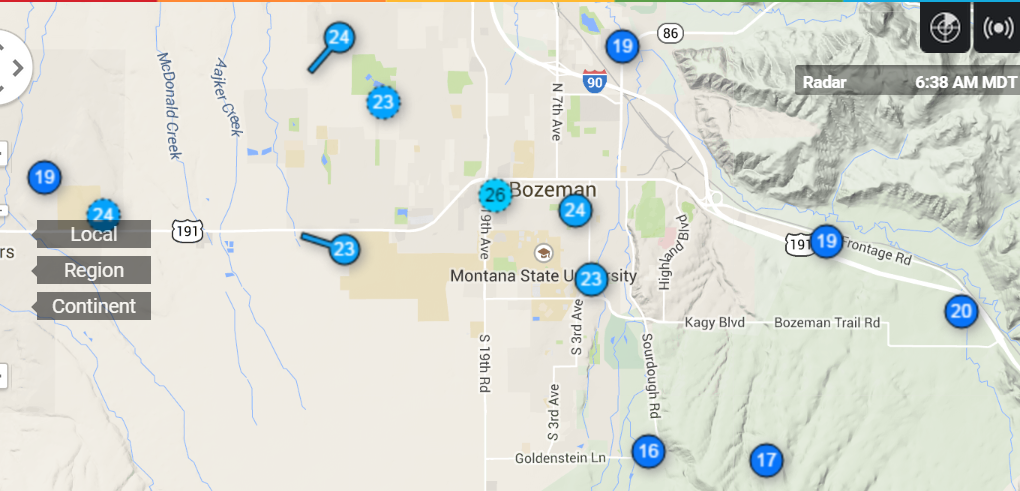
Even Bozeman, population of 40,000, has an urban heat island.


And I wish we resided in it this morning. Brrrrr!

Monday, April 6, 2015

Another April Day in Montana

From nearby Livingston....


We would show the Bozeman Pass webcam, just up the road from home, but that's up in the clouds and camera lenses are caked with snow and slush, so we added some porch photos (click on the photos to enlarge).


This is lower Mt. Ellis -- upper Mt. Ellis is completely obscured. Bozeman pass is off to the left.


This is a shot at the foot of Kelly Canyon (lower right), where William Clark (of Lewis and Clark) camped during his eastward return trip on July 14, 1806. Bozeman Pass is off to the right. Clark went left, following buffalo trails to take the longer but gentler Jackson Creek route across the Bridger Range, and then down to the Yellowstone River at Livingston.


Beyond the barns, looking the opposite direction, the vista goes down into Gallitan Valley.

Sunday, April 5, 2015

The Masters (Repost)

Masters week is here. The golfing world’s attention is focused on the lush fairways, rolling hills, lightening fast greens and historic layout of Augusta National Golf Course, located in Augusta Georgia, just south of the South Carolina border. For those not in the know, The Masters is the first of golf’s four majors – the others being the United States Open, The (British) Open Championship and the PGA Championship. The course and tournament are progeny of golf legend Bobby Jones, who nursed them from infancy to become the most renowned in golf.
     
Augusta National 13th Hole
The Masters is about renewal and rebirth.  It is played in a setting adorned by flowering spring bulbs, blooming azaleas and dogwoods, stately magnolias growing along both sides of the clubhouse lane and towering pines paralleling the fairways. By virtue of its early season position the Masters first creates and then limits possibility. Only the winner of The Masters can achieve the most coveted (and never accomplished in modern times) feat in golf – coming home victorious in each of the season’s four majors -- the Grand Slam.

The Masters is link between young and old -- it's the youngest of the majors and the same time is most revered. 

For the old of it, two time Masters champion, Ben Crenshaw, is playing in his final tournament. Fred Couples always seem to find the elixir of youth at Augusta. Fifty-seven year old Bernhard Langer finished top ten last year, and is playing some of the best golf of his life.  

On the young end, twenty-five year old Rory McIlroy, ranked world number one, and twenty-one year old Jordan Spieth, currently the hottest player, are the betting favorites. McIlroy is looking for his third straight major victory and to complete his career Grand Slam. Spieth will be looking to impress his buddies, who will be graduating from UT Austin in a few weeks, with his first major victory. And watch for Patrick Reid.

Victor Dubuisson (France), Martin Kaymer (Germany), Sergio Garcia (Spain) and Justin Rose (England) are strong contenders all.

Suddenly, it seems in a blink of an eye, Ernie Els, Phil Mickelson and Tiger Woods, are on the downside of their careers. They are in Augusta too, hoping to catch lightening in a bottle.

Don't forget about Dustin Johnson.

Arnold Palmer, Jack Nicklaus and Gary Player
The Big Three in their Masters Green Jackets
The Masters bestows uniquely among the majors the honor of first teeing off Thursday morning to living legends. This year again the honorees are Jack Nicklaus (6 time Masters champion), Arnold Palmer (4 time champion) and Gary Player (3 time Masters champion). They once dominated professional golf as the Big Three. Decades later they are being honored for lifetime achievement and lasting contributions.  They have earned the privilege of driving the first tee shots into the morning dew.   

Byron Nelson, Gene Sarazen and Sam Snead
For almost two decades the honorary threesome had been Sam Snead (3 time Masters champion), Byron Nelson (2 time Masters champion) and Gene Sarazen (1935 Masters champion), gentlemen who legitimized professional golf in the post Bobby Jones era. Sadly, they are no longer with us, but we still have memories of Snead’s syrupy slamming swing, Nelson’s ruthlessly efficient stroke and Sarazen’s elan. Ken Venturi had the honors once.

Jock Hutchison and Fred McLeod
First Honorary Starters
The remaining two members of the exclusive honorary starters club are Jock Hutchison and Fred McLeod, who paired up from 1963 through 1973, which happens to intersect with the nine years I caddied at Glen View Club in Golf, IL. Why those two? Neither man won The Masters. But each did win another important tournament at Augusta. Bobby Jones was an organizer of the PGA championship for senior golfers, what today is called the Senior PGA Champrionship. And the first two Senior PGAs were played at Augusta National Golf Club. Hutchison won the first one in 1937, and McCleod won the second one in 1938. 

Jock Hutchison was a member and retired club pro at Glen View Club. I caddied for him from time to time when I was teenager. Looking the octogenarian up and down, I did not believe a word the old guy said when he pointed to a club in his bag and said “I won the Open Championship with this mashie niblick laddie.” Such is the ignorance of youth. But thanks to Jock I can say today that I caddied for a World Golf Hall of Famer, a one-time honorary starter at the Masters and a British Open and PGA champion. I can say that with confidence because now we have the Internet.

Gary Player, Jack Nicklaus and Arnold Palmer walk across Hogan's bridge on the 12th hole at Augusta National before last year's champions dinner at the Masters.

Newsreel on Jock Hutchison's 1921 Open Championship.


Good luck to all.

Thursday, April 2, 2015

March Top 10

We're two days into April. It snowed yesterday. It snowed today. Snow is forecast for tomorrow night and Easter Sunday. Monday too. April is coming in like a lion. The weatherman calls them vigorous snow bands. Seems like a good time to look back on the sunny days of March. Here are the March top ten posts in Along the Gradyent.

1. My brother- and sister-in-law are diving feet first, and finances to the hilt, into the hottest new thing in apartment construction. Down in Ted Cruz land and the Lone Star state:
Cube Square is rising in Huntsville, Texas. One of the coolest new ideas in apartment construction is to build using inter-modal shipping containers. They call it Cargotecture. You have seen them on truck trailers, double stacked on flat bed train cars and stacked to the sky on cargo ships. Now they are beginning to appear on land, rising high in the latest green movement in apartment architecture.
America is a consumer nation, resulting in a surfeit of shipping containers inbound at U.S. ports -- many looking for a domestic home in lieu of an empty back haul. In our import intensive economy, the containers protect goods that are shipped in but are not needed in equal numbers for outbound export. A solution? Shipping container apartments: Reuse, repurpose and adorn to create a utilitarian industrial chic.  
For the full story and video links click through to the "The Cubes Are Coming, The Cubes Are Coming." 

2. I don't know if it is the record winter snows in the northeast, the prospect of Rory completing his career grand slam, or the speculation about what is happening with Tiger Woods, but people it seems are really looking forward to the Masters this year. In The Masters (Repost) we reprise our childhood connection with a gentleman who was in the first pair of honorary starters who kick off the tournament on Thursday mornings. 


Current honorary starters at the 2014 Masters -- Gary Player (black sweater), Arnold Palmer (green sweater), and Jack Nicklaus (blue sweater). 
3. People love childhood reminisces. So do I (sometimes I am not fully human, I get that). I wrote about my times and adventures as a baby boomer in the sleepy suburb of Morton Grove.
Half a block up and across the street was a field on the edge of the Cook County Forest Preserve, which with its bridle paths, heavily wooded areas, and riparian landscape presented all manner of opportunity for adventure and mischief. We captured butterflies, grasshoppers and lightening bugs, hung out in a "cave" along the river, climbed trees and explored the dump once located within.
I have been contacted by all sorts of people as a result of this post. One fellow, who was adopted, I was able to help track down his birth mother's trail, who sadly is deceased. But he was happy to finally know more of her and to meet his birth grandmother and an uncle who was a classmate of mine. There is more than meets the eye in Growing Up in Morton Grove.

"The Goal," March 16, 1973.
4. Wisconsin was in the Final Four in 1973 as well, except that time it was hockey, and our opponents were Cornell and Denver University. We reigned supreme in the old Boston Garden. Here's hoping that the Badger cagers are similarly successful this week in Indianapolis. Forty-Two Years Ago Today (Repost) looks back at our Bean Town trek, and the zany return trip we could never forget -- planes, trains, buses and automobiles, precipitated by a March blizzard in northwest Pennsylvania.

5. We like it when our top ten posts reprisals are well read, because that signifies readers saw something they liked here and are looking for more. So it is that we are proud that the February Top 10 came in strong for the month.

Bonnie Swearingen riding down
State Street, Chicago, Illinois.
6. Sometimes you meet the darnedest people on a golf course. When I was a teenager, that included John Swearingen, president and chairman of the board of Standard Oil (Indiana) and his southern belle wife, Bonnie Boulding. Whether it was the business or society pages, the New York Times, the Washington Post or the Chicago Tribune, or People Magazine, they were a couple worth talking and writing about -- and the media did, and did, and did. In John and Bonnie: A Profile in Oil, Finance, Politics and High Society, I do the same.


7. Before Google Maps and satellite views, there were aerial photos. I used one of these in Addendum to the Lincoln Tavern Post to add to my exegeses on one of the most notorious roadhouses in Morton Grove during the Al Capone and Prohibition era. I hope someday to get to finishing off a draft post about Fred Sonne, a Morton Grove resident and pilot, who invented and patented cameras that were used for many of these aerial reconnaissance shots, and hot spots like North Korea, the Soviet Union and Cuba in subsequent years.


8. AT&T entered the Dow Jones Industrials average in 1916. Now it is out so Tim Cook of Apple can make a federal case of whom does and does not bake wedding cakes for likes of himself. In Hello Good-Bye AT&T we profiled the life of Angus S. Hibbard, a pioneering telecommunications engineer, operations and marketing executive, and, it so happens, an orignal memeber of Glen View Club, where I caddied as a youth. That Bell System logo? It was a Hibbard creation. He did more to bind this nation together than Tim Cook can imagine. Tim Cook has done nothing except draft in Steve Jobs' wake.

9. My uncle, Lyndon R. Foster, was a great man. He died mere months before I ventured to California in 1975, so I never had the pleasure of making his acquaintance. There are World War I, disabled veteran, 1932 Los Angeles Olympics, China Town, mob and Ronald Reagan ascension to politics elements in the Lyn Foster story. Read all about it in On the Road to Bathgate Act 4f: Lyndon R. Foster -- Veteran, Publisher and Politician.

10. My hometown of Morton Grove, Illinois was a notorious hangout of mobsters and hoodlums during the Prohibtion era. By the time I was born and raised there in the 1950s and 1960s it was a Ward and June Cleaver kind of a suburb. In Morton Grove Mapped Through Time, we trace the physical transformation of the Chicago suburb that tracked its cultural evolution. 


A 1938 aerial photo showing greenhouses where the school I attended and the park of my youth were later located.


Glen View Club -- Focus on the First Quarter Century, Part I

Blogging on the history of a country club -- how, you might ask, has it come to that? 

Let me explain it this way. I was channel surfing the other night and came across a C-SPAN Q&A interview with Erik Larson author of "Dead Wake: The Last Crossing of the Lusitania," just published on the 100th anniversary of the sinking of the ship. When asked why write on the Lusitania, Mr. Larson emphasized two things -- he was interested to learn more on the topic, and he found a treasure trove of original material (in his case at the Hoover Institute on the campus of Stanford University). 

Then, Erik Larson replayed video he shot out of a low lying porthole, framing the dark, roiling and seemingly limitless cold expanse of the North Atlantic. The Lusitania was sunk in those unforgiving waters on May 7, 1915, with a loss of 1,198 of the 1,959 on board.  Larson said he voyaged across the Atlantic because when it came to writing history he considered it essential to have visited "the scene of the crime." To have been there, even a hundred years later, gave him a sense of perspective and stark reality that helped the story come alive. 

For me, Glen View Club was a scene I visited more than a thousand time from 1964 through 1972. It is a ready made backdrop for a story. As for interest, the club was founded when United States golf in particular, and our country in general, were growing up. Glen View is a stage that was populated by key actors in those processes, people such as Angus S. Hibbard, a telecommunications pioneer, urban planner and architect Daniel Burnham, and Jock Hutchison, the first United States citizen to win the British Open championship.  By virtue of Glen View Club's notoriety and the stature of its members, plus resources like newspapers.com, choniclingamerica.loc.gov, archives.chicagotribune.com and books.google.com, treasure laden archives are there for the researching.

Mr. Allen satisfied an early need to stock Glen View
Club with polo ponies. Chicago Tribune, April 5, 1898.
So it is with this post and more to come, that we blog on the early history of Glen View Club in Golf, Illinois -- the club's formation, its early membership, and its design and development. Originally founded as Glen View Golf and Polo Club in 1897, Glen View has long been a retreat for rest, recreation and respite of social and business aristocracy up Chicago's North Shore. For me it was a place where I learned how to toil.

Glen View Club's membership has included prominent politicians and leading doctors and lawyers, as well as captains of finance, industry and commerce, with some intellectuals and a legendary golfer or two thrown in for good measure.
Noted members through the years have included U.S. Presidents, William Howard Taft and Warren G. Harding, Vice President Charles Gates Dawes, and renowned amateur golfer, Charles “Chick” Evans. Chick was joined in the World Golf Hall of Fame by Jock Hutchison, who served as Glen View Club’s head professional for 35 years.
I remember well caddying in the 1960s for octogenarians Chick Evans and Jock Hutchison, both major champions during Glen View Club's early years. I will write separately on each in due course.

Glen View revolves around outdoor recreation -- golf, tennis and swimming in the summer, and paddle tennis and trap/skeet shooting in the fall and winter. Early on the club hosted the most important tournaments in American golf.
In 1899, Glen View Club hosted the first Western Open – one of five to be held on our course. The Club hosted the 1902 U.S. Amateur, which was won by member, Louis N. James, the first American born golfer to claim the title. In 1904, Willie Anderson won the third of his four U.S. Opens at Glen View Club.
Glen View Club's female 
curlers  had a sense of humor.
Glen View once had a rustic indoor curling rink with parallel ice sheets, overseen by a mezzanine wet bar that saw more action than what unfolded on the pebbled ice surfaces below. When winter weather cooperates, the club grounds open to members and guests for ice skating, cross-country skiing and snow shoeing.

Tuesday, March 31, 2015

NCAA Final Four -- On Wisconsin!

Wisconsin is in the Final Four -- basketball that is -- not hockey, which is startling to us old timers who graduated about a century ago. While the featured sport may have changed, some things don't. I'm talking about the music. Most are familiar with the "On Wiscosnin" fight song. There are two others -- a fun one "If You Want to Be a Badger" and a sentimental one "Varsity." Listen for each of the tunes Saturday night. Better yet, have a few beers and sing along!


If you want to be badger, just come along with me.
By the light.
Shining light.
By the light of the moon.


On Wisconsin. On Wisconsin.
Plunge right through that line.
Here we go, clear down the field boys.
Touchdown sure this time, (Uh, rah, rah)
Oh Wisconsin, On Wisconsin.
Fight on for her fame.
Fight fellas, fight, fight, fight we'll win this game.
Uh, rah, rah, Wisconsin.
Yea!


Varsity, Varisty, uh rah rah Wisconsin, praise to thee we sing.
Praise to thee our alma mater. Uh, rah, rah, Wisconsin.


And a few more for good measure, including our winning trip to the old Boston Garden in 1973.


Monday, March 30, 2015

Open Memo to Tim Cook and Apple

Mr. Cook:

You can marry whomever you want to marry. You can marry however many people you want to marry, as far as I am concerned. If I was qualified to marry you, I would do so. If I baked wedding cakes, I would bake yours. If I leased out a wedding hall, I would gladly rent it to you for the day. If I was your friend and you invited me to your wedding, I would attend. Or if you choose, you can live without the sanctity or commitment of marriage -- that is perfectly fine by me as well. Live and let live. The key here is your choice.

Now you have come out and demanded the police power of the state be lined up to force others to serve you and yours. You want your choices guaranteed by the state, but you don't want others to have the personal or religious freedom to exercise rights guaranteed for over two hundred years under the U.S. constitution. When you exercise your rights, you see it as a celebration of freedom. When other people exercise their rights, you see it as discrimination. That is unmitigated, self-centered bull. You insist the world be servant to you and yours.

Mr. Cook, you are a bully and a bum, and an embarrassment to the memory and legacy of Steve Jobs.

I will be exercising my freedom of choice going forward by having my family boycott Apple products and divesting myself of Apple stock. You don't get it. Good bye and good riddance Mr. Cook.

Freedom for all!

Sincerely,

Along the Gradyent.


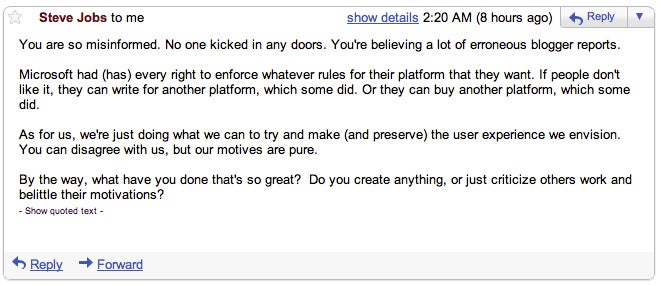
Steve Jobs staunchly defending Apple's (and Microsoft's) First Amendment rights and right to discriminate in a May, 2010 email.

Friday, March 27, 2015

We Are Number Six

Architectural rendering of new Town Pump, 19th Street in Bozeman.
In growth among micropolitan statistical areas, according to the U.S. Census Bureau.
The U.S. Census Bureau says Bozeman was the sixth-fastest growing “micropolitan” area in the nation from July 1, 2013, to July 1, 2014, with Gallatin County’s population increasing by 2.8 percent to an estimated 97,308 residents.
The fastest-growing micro area in 2013-2014 was Williston, North Dakota, with 8.7 percent growth, the bureau reports. Rounding out the top five on the micropolitan growth list were Dickinson, North Dakota; Heber, Utah; Andrews, Texas; and Vernal, Utah.
There are 536 micro areas in total, so that would put Bozeman just outside of the top one percent. The top two areas, Williston and Dickinson, are in the middle of the Bakken oil formation. Their growth should moderate substantially in 2015 with the recent 50 percent decline in wellhead oil prices substantially reducing drilling activity in the area.

So far, the local Bozeman county and city governments are welcoming of growth and spend much of their time taking on its challenges. But as the year goes by, and more people from the coasts move here to get away from it all, these people from the liberal lands will make up an increasing proportion of the local voting population. They will move to close the doors behind them and impose taxes, requirements and restrictions that discourage growth and make Bozeman a substantially more expensive place to live. Then they will decry the absence of affordable housing and blame it on rapacious business people. So it goes.


Service line at new Five Guys in Bozeman.
Now the truth be known, the Census really doesn't know what populations are but every ten years. In between decennial censuses the bureau imputes populations using birth, death, and other demographic and real estate data, along with a dosage of statistical benchmarking. Despite their best but distant and partially informed efforts, most population data need to be substantially revised by the time of the next decennial census. Based on the growth in traffic, expansion of local retail (food and service stations), and the local proliferation of construction sites, I am betting that the Census Bureau estimate for Bozeman is understated. We shall see in time.


Tuesday, March 24, 2015

Another Day in Montana

A couple of guys didn't make it to work this morning.

On my way to golf past Four Corners, a little road rage, cars screech to a halt off the side of the road, drivers exit and engage in fisticuffs, shots fired ...

Subject vehicles pulled off into parking lot for fist fight and gun shots. We settle up our bets after golf in the Korner Bar & Cafe.
Here is the news report:

FOUR CORNERS - A road-rage incident escalated into a fight and gunfire this morning near Four Corners.
According to the Gallatin County Sheriff's Department, at 8:22 a.m. deputies responded to a report of a fight and gun shots in the parking lot of the Korner Club in Four Corners.
Initial reports indicated that a road rage incident involving two vehicles turned into a fight, followed by one man producing a gun and firing.
Deputies were on the scene quickly and the two men were detained.
One man was transported to Bozeman Deaconess for a cut above his eye from the fight - not the result of a gunshot.
Detectives are interviewing witnesses and investigating the scene to determine what charges will be filed.
Then at Cottonwood Hills the thermometer never cracked 40 and we were snowed out on the back nine -- just another day in Montana.


Monday, March 23, 2015

Obama's Stimulus Keeps On Giving

...us great stories on the absurdity of government spending and Democratic profligacy.


The gossip sheets are reporting that Justin Timberlake and Jessica Biel will be raising their baby up the road at Big Sky, where they've purchased property at the Yellowstone Club. It's gorgeous, it's exclusive, it's private.

Homesites are available for from $1.65 million to $4.45 million. Condos are available for $5 million to $16.5 million. Custom residences run from $3.65 million to $16.9 million.
Yellowstone Club is a 13,600 acre private residential community set amidst the grandeur of the Rocky Mountains. The Club's superior amenities, easy Montana charm and overwhelming natural beauty present an incomparable venue for mountain living, year-round recreation, and cherished family traditions. Explore the spectacular beauty of the World's only private ski and golf community and the benefits of membership in this exclusive one-of-a-kind club. In addition to the 2,200 acres of powder drenched trails of world-class skiing in the winter and an 18-hole Tom Weiskopf-designed mountain golf course for the summer months, we have a full Outdoor Pursuits program for unparalleled mountain adventures.
And cable television and redundant high speed internet access have been granted gratis to Yellowstone Club residents via Barack Obama and the American taxpayer.

Justin Timberlake and Jennifer Biel were reported to have tied the knot down in Jackson Hole. Now they are bringing their act up to the more exclusive environs of the Yellowstone Club, in Big Sky.
Now, I brook no complaint or jealousy over whatever riches this attractive couple has accumulated. But please, does anyone think they need be beneficiaries of the Obama administration's shovel ready spending?

Check it out. It's a gorgeous place -- and private, private, private.


So you thought Obama's stimulus was done?  Nah, it keeps on cranking away.
West of Bozeman, crews are busily laying cable for Opticom between Belgrade and Big Sky (playground and ski resort for the rich and famous), along Ted Turner's ranch and other intermediate points.
The cables have been laid. The internet is humming. Hundreds of television channels are being piped in. And so it is that Justin and his squeeze, and neighbor Bill Gates, will become the latest beneficiaries of outrageous government largess. How large? Illinois Senator Mark Kirk laid it out for us.
The Silver Fleece Award for the month of July [went] to a $64 million Stimulus award to provide broadband service to Gallatin County, Montana. According to an analysis conducted by Navigant Consulting, 93% of the households in the project's proposed service area were already served by five or more broadband providers. The fact that tens of millions of taxpayer dollars were spent to subsidize broadband service in an area with already strong private sector representation is reprehensible. Perhaps even more staggering, though, is the taxpayer cost of these services per unserved household.
Ted Turner on his Flying D Ranch, Bozeman, Montana
According to the program's own definition of "unserved household", this project cost taxpayers more than $340,000 per unserved household. However, many of these so-called unserved households have access to 3G wireless broadband. Not only are 3G speeds approaching or even meeting Administration broadband standards, but 3G will soon be replaced with 4G broadband, which will far exceed current standards. Subtracting the number of homes that had existing access to 3G wireless leaves only 7 households in the Gallatin County service area unserved by broadband. It cost the U.S. taxpayer an astounding $7,112,422 per household to provide broadband service to the truly unserved population.
The next time some Democratic politician demagogues on the need for spending on infrastructure, remember, this is what they have in mind. You get the government you vote for and I hope you are happy with it.


Wednesday, March 18, 2015

Isaac J. Foster and Laura Elizabeth Armstrong Wedding Announcement

We were delighted to find the other day this one hundred and fifteen year old wedding announcement, noting my grandparents' nuptials.
Pembina Pioneer Express, June 6, 1890
Foster – Armstrong – At the residence of the bride’s sister, Mrs. R. D. Hoskins, by Rev. John Scott, of Walhalla, on Thursday evening, May 28th, 1890, Isaac J. Foster to Miss L. Elizabeth Armstrong, both of Bathgate, N. D.
The bride and groom are so well known to our citizens that to say that they have the well wishes of all, is unnecessary, as neither of them have an enemy who would wish them ill. The wedding was a quiet one, owing to the illness of the bride’s mother, Mrs. J. A. Armstrong, but a very pleasant one to those in attendance. May they enjoy a long life and prosperity, is the wish of all. They have gone housekeeping in the R. D. Hoskins house, which Ike has bought. – Bathgate Democrat. 

My aunt Laura Albina Foster was born later that year, which would seem to explain the timing of the wedding and pressing ahead despite my great grandmother's illness. Ten more children would be born to the union, including my father, George W. Foster, the eleventh and final in the brood.

It will be recalled that the Hoskins had moved on to Bismarck early that year, where R. D. Hoskins had been named the first clerk of the state supreme court on North Dakota's attaining statehood.

The Pembina Pioneer Express had gone on line this last year after we had written a series of posts on Ike Foster. We look forward to using the newspaper as an especially valuable resource when we write going forward. 

The Pioneer Express was the newspaper of record for Pembina county and reported on many of Ike Foster's doings in the then county seat, whether they involved his tenure as country sheriff, his raising of crops or involvement in animal husbandry, his land sales business or his incredibly active auction business. The latter three topics we have yet to write on.

The Express fills important gaps from the fifteen year period when editions of the local Bathgate paper are missing from the North Dakota State Historical Society archives. Perhaps more importantly, the editor of the Express had a sense of humor and an editorial eye for Ike's style and personality that make him come to life in ways that are only hinted at in other sources we have come across. This should be fun.  

Run, Hillary Run

From a Hillary Cliinton for President PAC.


I think a blue dress says Bill more, not?

Tuesday, March 17, 2015

St. Patrick's Day Honoree 2015: William K. Foster

William K. Foster
March 20, 1835 - September 27, 1902


Foster Irish crest.
On this St. Patrick's Day 2015, we honor our pioneering great grandfather, William K. Foster, who 165 years ago (April 18, 1849) boarded the sailing vessel Bridgetown at New Ross, County Wexford, Ireland to cross the Atlantic Ocean. Six weeks later, on June 1, 1849, William, his widowed mother, and four siblings, landed in Quebec and were thus freed from the throes of the Irish Potato Famine. No doubt they were thankful to have made it safely to Canada for the trip was fraught with hazard.
Traveling to America by ship during the Irish Famine could be quite perilous. In the mid-19th century, English landlords looking to evict penniless Irish tenants would pay to have them shipped to British North America. In many cases these ships were poorly built, crowded, disease-ridden, and short of food, supplies and medical services. As a result, many Irish immigrants contracted diseases such as typhus, and many others died before reaching land. Of the 100,000 Irish that sailed to British North America in 1847, one out of five died from disease and malnutrition. Appropriately, these treacherous sailing vessels became known as “coffin ships.”
On a voyage across the Atlantic in 1847, dozens aboard the Bridgetown succumbed to the fever (typhus) and were buried at sea, leaving many orphans. A passenger wrote from island quarantine:
We arrived here on the 22nd from Liverpool. I regret to tell you that fever broke out, and that seventy passengers and one sailor were committed to the deep on the voyage. There are several more ill. We buried six yesterday on shore. The carpenter and joiner are occupied making coffins. There are six more dead after the night. I cannot say when we can go to Quebec, as we cannot land the remainder of the sick at present, there being no room in the hospitals for them, though the front of the island is literally covered with sheds and tents. 
The accounts from the shore are awful, and our condition on board you can form no idea of — helpless children without parents or relatives, the father buried in the deep last week, and the mother the week before, — their six children under similar unfortunate circumstances, and so on. I trust God will carry me through this trying ordeal — I was a few days sick, but am now recovered. Captain Wilson was complaining for a few days. It is an awful change from the joyous hopes with which most of us left our unfortunate country, expecting to be able to earn that livelihood denied us at home — all — all changed in many cases to bitter deep despair.
The Bridgetown would be lost at sea off the coast of New Foundland in August, 1850. 
[T]he ship "Bridgetown," from Liverpool, with 347 passengers, was wrecked on the coast of Newfoundland, near Cape Race, on the 4th of August. Excepting three children, the passengers were saved and conveyed to St. John's, whence three vessels arrived with them at this port, on the 10th of September. The passengers by the "Wave" and "Bridgetown," landed here in a very destitute state, having lost all their baggage, on which account they caused a heavy expenditure to the department. The outlay incurred at this and the Montreal agency, for their inland transport and provisions, was 152£ 5s., for which expense, owing to the loss of the vessels, no dues had been received.
Having survived their voyage unscathed, the Foster family adventure in the New World began.

Great great grandmother Margaret Roach Foster, an
d children Hariett, 24, James, 21, Elizabeth 18, William K., 14, and Isaac, 12, settled in Kemptville, Ontario, located thirty-five miles south of Ottawa.  William came of age, apprenticed as and became a journeyman cabinet maker, a profession which included coffin making. He met Margaret Sanderson, daughter of Scottish immigrants. They married on May 3, 1859. She bore him five sons -- Isaac (my grandfather), George, William, James and Robert. Great grandmother Margaret died of complications from childbirth the week following Robert's birth. The widower William subsequently married Nancy Jane Loucks, who bore him a sixth child, Emily Rellia. 

William Foster headed yet further west in 1874, first to Pembina, Dakota territory. Pembina was the original county seat of Pembina county. It is tucked under the international border in the extreme northeast corner of North Dakota, seventy miles south of Winnepeg, Manitoba. In 1879, William moved on to his final place of residence, homesteading in Bathgate, Dakota territory, fifteen miles southwest of Pembina. William was an original -- literally the town father. 

The founding of Bathgate is chronicled in "Proudly We Speak, A History of Neche, Hyde Park, Bruce and Bathgate."

In this 1893 plat William K. Foster owned a quarter section west of town, plus a
145 acre plot south of town. He donated a triangular plot east of the railroad for the
town cemetery, where he is interred.  The town of  Bathgate is located on land my
great grandfather originally homesteaded. The quarter section north of town is held
at that time by my grandfather Isaac (I. J.) Foster.
William Foster, Sr. and his son "Ike" filed on the land which became the Bathgate townsite. There are several stories of how the town came to be called Bathgate. One taken from the diary of Mrs. John Houston, daughter of Mr. and Mrs. William Campbell states that in July 1880 two men with a team of horses came to the Campbell home, the land now owned by the Thomas and James Martindale families and asked to stay over night. The men were Comstock and White of the Land Company of Comstock and White, who had purchased the land for a townsite from the Fosters. They went on to Winnipeg, locating townsites along the railroad. On their return,they again stayed over night and Mr. Comstock said that the townsite would be named Bathgate after the town in England, where his wife had lived.
A Mr. Ewing was hired to plot the town into lots, streets and avenues. The Railroad brought the Boom. People came, buildings sprang up, businesses were started and the town grew. The St. Paul, Minneapolis and Manitoba Railroad was built from Grand Forks to Winnipeg. It reached Bathgate August 10,1882. Service began in September, the north train arriving in the morning and the south bound train in the late afternoon. In 1890, this railroad became the Great Northern with the well known Jim Hill as President of the Company. The first grain was shipped September 27, 1882. The telegraph came to Bathgate late in 1882.
William K. was active in the town's development far beyond his role in selling his original quarter section off to a developer. "Proudly We Speak" continues,
William Foster was the first to build a home, it was built in the north end of town. He built the building which housed the Post Office. Mr. Foster was the first Postmaster. 
Appointment as original Bathgate postmaster, Black Hills Weekly Pioneer, December 3 1881.
He carried the mail horseback from Hamilton P.O., five miles south of Bathgate and two miles northwest of Hamilton to the Pembina-Cavalier Trail. He performed this service without pay for two years. William Foster was the town's promoter. Church services were held in his house. He donated land for the Cemetery. He and his sons promoted various business ventur
es.
In additional to selling the land which was developed by Comstock and White, the Fosters retained land to the immediate north which was platted, subdivided and marketed as Foster's Addition to Bathgate. William K. Foster avidly promoted the lots, the town and the territory of Dakota in general.

For his efforts the editor of the local newspaper referred to William Foster as Mayor, an honorific, not legally conferred, title.

William Foster said that Bathgate was "high and dry," not subject to the all too frequent devastating floods that occured a dozen miles east along the "overflowing Red."


Bathgate Sentinel, May 16, 1882
The "Bathgate Sentinel" was quick to confirm the accuracy of advertisements promoting the town. 
Bathgate Sentinel, May 16, 1882
There is not a word of exaggeration in the advertisements of our townsite proprietors Messrs. Comstock & White, and Mr. W. Foster. Located as Bathgate is on a beautiful river, almost in the centre of the rich, and wonderously fertile County of Pembina, and soon to become the great railroad centre, no town can offer better inducements to capital, energy and brains. Everybody sees the superior advantages Bathgate has over all other towns in the county, the beautiful high location; fourteen miles from the raging Red, that has caused so much damage along its banks; a great railroad centre, and a soil extending in every direction from ten to twenty miles that is unrivaled for richness and elevation.
William K. Foster touted the special advantages of Foster's addition in ads placed in the "Pembina Pioneer Express."


Pembina Pioneer Express, June 22 1883.
William Foster's enthusiasm never dimmed.

Pembina Pioneer Express, February 15, 1884
Wm. Foster visited several of the towns in the county last week, but comes back satisfied to remain in Bathgate, although the numerous houses built up around him obstruct the wide view of the surrounding country, which he had when his was the only shanty within several miles of the present town. Mr. Foster says: "This is God's own Country, it can't be beat."
We thank God for the pioneering spirit and drive of our ancestor William K. Foster, and honor him for that and his heritage today, St. Patricks Day 2015. Thanks to him the road has risen to meet us and the wind blows to this day behind our backs. Happy St. Patrick's day great grandfather!

Monday, March 16, 2015

Fourty-Two Years Ago Today (Repost)

On March 16, 1973, spring was in the air, and we were on the ground in Boston, Massachusetts, not to partake in the St. Patrick Day festivities, but on a road trip to the NCAA National Hockey Championship (now known as the Frozen Four). We had driven twenty hours straight through from Madison, Wisconsin to root the Badgers on in a semi-final game. It was a notable trip out, followed by a dramatic tournament, and a trip home (read this post to the end) that we would never forget.  

Wisconsin's semifinal was scheduled for Friday night. The Wisconsin Badgers hockey club, a young up and coming team that had yet to win a national championship, were slated to face off against the powerhouse Cornell Big Red, winners of the NCAA tournament two of the previous five years. Cornell had recently graduated Ken Dryden, a goalie who went on to win the Conn Smythe trophy, as the most valuable player in the NHL Stanley Cup playoffs, during his pre-rookie year with the Montreal Canadians.  Dryden is probably best known to the casual fan as the announcer who did the color commentary, during Al Michael's dramatic play-by-play call of the the U.S. hockey team's "Miracle on Ice" victory over the Soviet Union, at the Lake Placid Olympics in 1980. Cornell was heavily favored. Wisconsin was heavily supported by its fans.