Saturday, May 2, 2015

April Top 10 Posts

Readership surged in April. Measured by page views, last month at Along the Gradyent was our second highest month since inception. A Bozeman story and a caddie life inspired piece were numbers one and two, followed by Morton Grove, golf, Huntsville, caddie life, caddie life, and Morton Grove and Morton Grove. Here are the top ten posts.

1.  Jens Hagen Anderson grew up not far from our home here in Bozeman, up Kelly Canyon Road, near the gap at the canyon's top that was traversed by William Clark of the Lewis and Clark expedition (guided by Sacajawea) on July 15, 1806, during the return trip. Clark had split off from Lewis in order to explore the Yellowstone River basin, which his party would enter late that day after hiking up the Jackson Creek drainage and crossing Bozeman Pass. 

Jens was an avid backcountry skier and photographer. He was super experienced, super prepared, super careful and a super guy, it is reliably reported.
And my gosh, Safety Sam, you were such a pain to ski the backcountry with. Digging pits even in low risk, low consequence situations. And I know it was how you were raised, but you really took that Anderson Family Adventure Pact to the extreme: "If you have a bad feeling, even if you're not sure why, you have to speak up. I'd rather us all bail than have something bad happen we'll regret." And you clearly had no problem speaking up. Every time you did, we'd spend the day on slopes so flat I had to pole just to go anywhere. But you don't have to tell me. I know you saved your family's lives that one time on Granite Peak, turning everyone back from what would become a deadly lightning storm. And I'm sure you saved mine a few times too.
What's so hard to understand, though, is just where was your Jensie Sense this time? Why didn't it kick in? I know, that snowpack was so stable. You guys managed your risk to a fault. And Jens, when you took the lower section first, saying, "Why don't I go down a little ways and get some pictures of you guys," that was so like you. 
You lugged that big dSLR on your chest everywhere, and sometimes the batteries were even charged. You loved photography, but even more, you loved preserving memories with friends and sharing the beauty you'd seen with anyone who would look. And it wasn't just that boat-anchor of a camera you carried. On every outing, yours was the biggest pack, stuffed with extra clothes for anyone who got cold, a big first aid kit so you could take care of us, and on longer trips, at least one can of Coors Banquet for everyone in the party.
Skiing a couloir down Beehive Peak near Hanging Garden on April 11, 2015 Jens Hagen Anderson triggered the tiniest of avalanches in a chute where there was no room for error. His day and life ended Skiing Into Oblivion. May he rest in peace. Our condolences and prayers to his family and friends. Here is the video of the life celebration in his remembrance held a week after his passing at the Commons out Baxter Lane.  

Jens Hagen Anderson - a Celebration of Life from Journey Church on Vimeo.

Union Station, Wash. DC, by Daniel Burnham, architect.
2. Glen View Club in Golf, Illinois was established in 1897. It was founded at a time when golf in the United States and our country itself were growing up. The country club is an incredible backdrop for stories about both. Founding members included Daniel Burnham, an architect of things grand and a city planner, who was responsible for the design and construction of the Columbian Exposition, a magnificently successful world's fair which entertained on the City of Chicago waterfront in 1892 (the 400th anniversary of Columbus' discovery of America) and 1893 (held over due to its enormous success). Also there at Glen View's beginning was William Holabird, an architect whose firm aside from the standard structure and skyscraper fare, was responsible for the design of the iconic art deco hand operated scoreboard that operates in Wrigley Field, Chicago -- home of the Chicago Cubs -- to this day. And there was pioneering landscape architect Ossian E. Simonds who became one before there was such a profession. Read all about it in Glen View Club: Focus on the First Quarter Century, Part I.

Wrigley Field scoreboard and center field bleacher construction project, 1937. Architects Holabird and Root


3. Little did I know when close-up photos of Russian missile sites appeared on the front pages of newspapers and the nightly news in 1962 (I was nine years old) that those images were made possible by the skill, creativity and inventiveness of a man who hailed from my hometown of Morton Grove, Illinois. Read about the man, the times and the places in Morton Grove Before the Baby Boom: Fred Sonne -- Pilot, Innovator and Aerial Photographer.


4. A perennial favorite, The Masters (Repost) ratcheted to fourth in April. This year, we suspected that youth would be served, but weren't quite sure which young man that meant.
[T]wenty-five year old Rory McIlroy, ranked world number one, and twenty-one year old Jordan Spieth, currently the hottest player, are the betting favorites. McIlroy is looking for his third straight major victory and to complete his career Grand Slam. Spieth will be looking to impress his buddies, who will be graduating from UT Austin in a few weeks, with his first major victory.
As it turned out, Spieth threatened to lap the field. He finished with a wire-to-wire victory, tying Tiger Woods 1997 scoring record. Everyone agrees there will be many more majors to come.

5. The in-laws are making quite a splash with the design and construction of the new "Cube Square" apartment complex in Huntsville, Texas -- target market, students at Sam Houston State university. 
When driving down Sycamore Avenue, it’s almost impossible not to notice the multicolored shipping containers stacked one on top of another.
These containers are not being used in conventional fashion, however. They soon will be rentable apartments, which Wagamon Enterprises hopes to begin leasing this summer.
“The whole idea behind doing them in shipping containers is just because it’s cool,” general contractor Jack Wagamon said. “It’s student housing so we want to make it look cool. Kids like that kind of thing.
“Most of the growth on Sycamore over the last five years has been all this student housing,” he added. “So, we’re just trying to take advantage of that.”
See the pictures and check out the video links in The Cubes Are Coming, The Cubes Are Coming.


6. One Sunday morning during the 1960s civil rights era we caddies at Glen View Club in Golf Illinois went on strike. We borrowed the anthem and slogans of the cause to make our point for a raise melodically during the wildcat action. In The Caddies Thank You Dr. King! we give the background and a descriptions of one the shortest, most unusual and successful strikes known to the history of labor relations. I mean how many times have you seen a hundred caddies march out to a driving range, sit down on the grounds and sing "We Shall Overcome?"

7. In this big month for our caddie stories the John and Bonnie show repeated on the top ten list. To me they were a member and his wife. To People Magazine in 1981:
As human beings they are poles apart, but together John and Bonnie Swearingen comprise one of the business world's most magnetic couples. At 63, he, the portly, scholarly and conservative $635,000-a-year chairman of Standard Oil Company (Indiana). Bonnie, about 50 (the number is unlisted) is a bubbly Southern belle, who tried four times to be Miss Alabama, had a fling as an actress and is now arching eyebrows in her adopted hometown of Chicago with her sexy outfits and sassy talk. She collects famous friends and calls one and all "Honey." A longtime associate of John's concedes, "She has put a wide smile on his face -- he used to be so grim."
Spokane Spokesman Review, September 12, 1970
John Swearingen swaggered into the public forum, taking on Ralph Nader, Phil Donahue and Jimmy Carter. Bonnie Swearingen sashayed on to the national social scene taking on staid blue blood convention. We report their dance here in John and Bonnie: A Profile in Oil, Finance, Politics and High Society.

8. Growing Up In Morton Grove is another perennial favorite drawing new notice every time we post a vignette on Morton Grove history. 


The Dells 1925 Ad.
9. By the time I was a child the northwest corner of Austin Ave. and Dempster St. in Morton Grove, Illinois was a strip shopping center, with a Rexall Drug, Gene's Bakery, a dry cleaner, the Ben Franklin 5 & 10 and a National Tea grocery store. For two decades it more or less coincident with the Volstead Act and Prohibition, it had bee the site of the Dells.
The Dells was an incredibly popular and successful commercial enterprise. It boasted a spacious dance floor, broadcast its music performances over the radio airwaves, and, because it was not subjected to the musician union local controls within the city, freely imported nationally renowned musicians and entertainers. The Dells had tasty cuisine -- steak, poultry, seafood and even frogs legs -- in a well appointed setting on a tranquil wooded lot.
There was more, of course, because The Dells' prosperous run was concurrent, not the least bit coincidentally, with the Volstead Act and prohibition. Additional attractions included beer, liquor and gambling and gangland wars over the profits of the same. The Dells was said to be owned or controlled by Al Capone and his gang. It is commonly referred to as the most notorious of the Morton Grove roadhouses.
Corner of Austin and Dempster, circa 1960.
In Morton Grove Before the Baby Boom: The Complete Story of The Dells we regaled readers with stories of the turf wars, kidnappings, arson and murders that characterized the roadhouse's tumultuous history. 

10. The March Top 10 Posts makes for a nice bookend to the Top April Top 10 Posts. So it is.

Thursday, April 30, 2015

Calvin Peete, 1943-2015

Here is to a man who lived the dash. I can't say it any better, so here is a tribute to and a remembrance of a man who overcame incredibly long odds to accomplish so much, and had not an immodest bone in his body.


Calvin Peete, 1943-2015: One of golf's least likely champions

Calvin Peete had an aversion to heat that was rooted in the summers of his youth and long hours picking corn and beans beneath Florida’s blistering sun. It left sweat stains on his soul that would not allow him even to keep a vegetable garden at home.
One day, friends invited him to play golf. “Who wants to chase a ball under the hot sun?” he asked rhetorically.
Peete, who died Wednesday morning at 71, was as unlikely a champion as golf ever produced. There was his upbringing; he was one of 19 kids from his father’s two marriages and was a high school dropout who worked in the fields “from sunup to sundown,” People magazine once wrote, “or, as he would say, from ‘can to cain’t.’” He had diamonds implanted in his two front teeth and sold jewelry to migrant farm workers. He did not take up golf until he was 23, and in a sport that preaches left arm straight, his was permanently bent from falling off a tree and breaking it.
Calvin.jpg
He not only took up golf, he became proficient at it, winning 12 tournaments, including the Players Championship in 1985. Eleven of those victories came from 1982 through 1986, more than any other player, and spent 20 weeks in the top 10 in the World Ranking. He won the Vardon Trophy for lowest scoring average in 1983. Jack Nicklaus was second. He also played on U.S. Ryder Cup teams in 1983 and 1985.
“Calvin was an inspiration to so many people,” PGA Tour Commissioner Tim Finchem said in a statement. “He started in the game relatively late in life but quickly became one of the tour’s best players, winning and winning often despite the hardship of his injured arm.”
His arm was crooked, but his forte was straight. For 10 consecutive years, from 1981 through his last full season in 1990, he led the PGA Tour in driving accuracy. In 1983, he hit 84.55 percent of the fairways. He also led the tour in greens in regulation on three occasions.
Peete was a quick study. Within six months of taking up golf, he was breaking 80. A year later, he was breaking par. He never took a lesson, but read instructional books by Hogan and Snead, Nicklaus and Toski. At the age of 32, he earned his PGA Tour membership.
“I can still remember watching Calvin hit drive after drive straight down the middle of the fairway, an amazing display of talent he possessed despite some of his physical limitations,” Finchem said. “Throughout his life, he gave so much, and we especially noticed it when he moved to Ponte Vedra Beach as he continued to support the community, the PGA Tour and our various charitable pursuits.
“Along with his wife, Pepper, he made such a difference working with the First Tee and junior golf in this area. Calvin will always be remembered as a great champion and an individual who consistently gave back to the game. We will dearly miss him.”
World Golf Hall of Fame take note. Honoring success is rooted in more than the number of majors a golfer wins. Rest in peace, Calvin Peete.


Wednesday, April 29, 2015

No Root, Root for the Home Team, Baltimore Orioles Style

"O" "R" "I" "O" "L" "E" "S"

Wild Bill Hagy is turning over in his grave.


There won't be anybody taking anyone out to the ball game in Baltimore today. No peanuts. No Crackerjack -- nada. No spectators will be allowed today to watch Orioles baseball against the Chicago White Sox at Camden Yards.


How did it come to this?

The National Capital region has benefited from a massive spending bomb the last ten to fifteen years in the worlds of Bush and Obama. We blogged again and again on the incredible affluence that club fed has showered on its community. So, of course, when the populous goes off the rails, what is the answer? Yes, it is to spend and spend more. That's what we hear from congressional leadership
WASHINGTON — House Minority Whip Steny Hoyer defended Baltimore city officials’ reaction to the riots erupting in the city by asking for more federal tax dollars.

The Daily Caller asked Hoyer, a Maryland Democrat, if the city’s leadership had failed, since the West Baltimore area was still being rebuilt from the 1968 riots. Hoyer replied, “We have to invest in making sure that we have proper infrastructure and proper housing so that we have neighborhoods that are safe and that we safe conditions in which to live.”
“But I wouldn’t call it a failure, certainly, of Baltimore,” he added. “But we’re going to have to as a country invest if we’re going to have the kinds of communities we want.”
Dear President put his typically divisive spin on the same, pulling out his shopworn can't get nothing from nobody, rhetorical slam.
The President took aim at the Republican-controlled Congress, saying he was “under no illusion that out of this Congress we’re going to get massive investments in urban communities.”

And now, what is Baltimore doing to succor itself? It's driving economic activity away.

The city has three huge economic engines that collectively bring in billions of dollars from neighboring jurisdictions.

Inner Harbor is a 365 day a year draw, with attractions including museums, performance venues, historic vessels, shops, restaurants and the immodestly named National Aquarium at Baltimore.
  • Inner Harbor supports substantial employment (21,000 jobs) and economic impacts ($2.3 billion) annually for the City of Baltimore and the State of Maryland;
  • Of the 23.3 million visitors who came to Baltimore in 2012, 14 million people from outside of the region visited the Inner Harbor, according to preliminary data. That’s 60% of all visitors to Baltimore who generate economic activity throughout the City; and
  • Inner Harbor tourism and business activity accounts for $102 million in annual tax revenue to the City and State.
Inner Harbor is now attracting a different sort of crowd. Says the New York Times, "Throughout Tuesday, state troopers in riot gear and National Guards members patrolled the Inner Harbor tourist district and around downtown Baltimore hotels." Even when business "returns," look for patronage at Inner Harbor to drop at least fifty percent. 

As for the baseball stadium operation it support 2,500 jobs, produces probably a couple hundred million in wages and salaries, contributes up to half a billion to the state economy, and at least $25 million dollars into state and local coffers. Expect to see a downward draft in attendance and revenues, with the beneficiary being Nationals Park in DC. 

The third economic magnet is the M&T Stadium which hosts the Ravens. Only it not being in season protects a negative economic impact.

Way to go Baltimore. Geez.


Monday, April 27, 2015

Watch the Sign

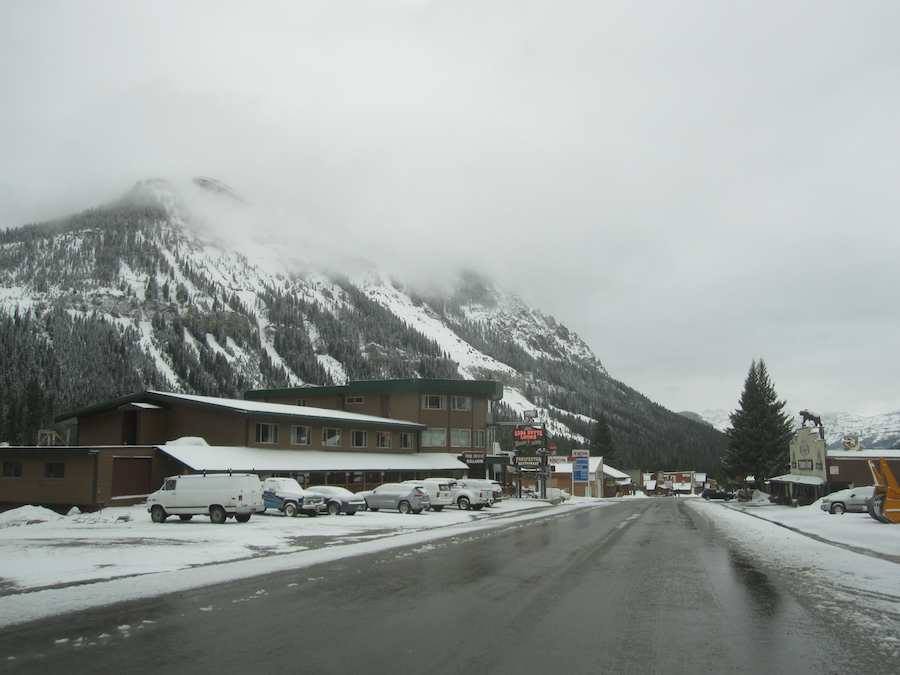
We-know-better thinking is alive and well among the flatlanders. Temperatures drop, on average, 3.5 degrees for every 1,000 foot increase in elevation. Roads closed in winter means until late May or even June when the road rises above 10,000 feet.

Women rescued from Beartooth Highway

BILLINGS -
Two women were rescued from the Beartooth Highway on Saturday after becoming stuck in a snowdrift four miles east of Cooke City, Montana.
Both 24-years-old and from Massachusetts and Iowa, their vehicle became stuck in a drift piled in the middle of the highway, according to Park County Sheriff's Office.
In the press release, it stated one woman admitted she drove past the road closed sign on Highway 212 east of Cooke City because she couldn't understand why the road would be closed. The women stated that they did have warm clothes and a small amount of food but no water.
Since the women were unsure of their location, Park County Wyoming's Search and Rescue was activated.
They were found just west of the state line on Highway 212 in Montana.
Two hours after becoming stuck, the vehicle was freed around 11:30 p.m.
Park County Sheriff Scott Steward once again cautioned residents and visitors alike to verify road conditions before venturing into the mountains. “Road conditions can change rapidly at this time of the year, and anyone intending to drive into the mountains should be prepared for inclement conditions,” said Sheriff Steward. “Also, besides checking conditions prior to departure, motorists need to heed any and all posted warning signs.”
To check highway conditions anywhere in Wyoming, dial 1-888-WYO-ROAD or check the Wyoming Department of Transportation's website.

We never travel in the Rocky mountains without a generous supply of water on board. The young ladies were very fortunate. The last couple to blow through the closure sign waited a week to be found. They wrote farewell notes to family and friends.
The highway is a real bear.
Beartooth Highway is a 68 mile stretch of US Highway 212 that, from its western most terminus at the Northeast entrance to Yellowstone National Park, runs east to Red Lodge, Montana. While the Highway begins and ends in Montana, a large portion lies within the northwest corner of the State of Wyoming. Because the Beartooth Highway lies within National Forest and National Wilderness boundaries services along the route are limited to rest areas and interpretive sites, with the exception of one commercial property – Top of the World Store – located close to Island Lake Campground. Three communities, the Road’s “gateway communities”, provide access to the Highway, as well as full visitor services. This is important to note as these communities will be used as “home base” for travelers wanting to explore the Highway and surrounding Yellowstone Country.
Beartooth Pass, May 26,, 2014.
Be Weather Ready
Reaching 10,977 feet at Beartooth Pass, and surrounded by 20 mountain peaks that reach over 12,000 feet, the Beartooth Highway crosses some of the most extreme country in the world. The high alpine climate ensures that severe weather conditions occur almost every month of the year. Summertime temperatures can range from the 70s on sunny days to below freezing during sudden snowstorms. Keep these extreme conditions in mind when planning a visit to the Beartooth Highway. Pack appropriate clothing including warm jackets and hats. Those planning outdoor recreation time may want to include additional foot wear and other items that will provide more warmth.
The road is normally plowed by Memorial Day, but closures are common through June due to spring snow storms. From the opening near Memorial Day, the road is seldom closed more than one day to remove the snow. It is not uncommon to experience blizzard type conditions both in the spring and the fall, especially at higher elevations. When these events occur, travel is slowed considerably or the highway is closed until it can be reopened by maintenance crews. Being aware of these possible weather conditional

Be prepared out there and have a great day everyone!


Saturday, April 25, 2015

Remember to Dress Appropraitely

If you plan to visit Montana in the spring. This Saturday morning....

The ridge on the Bridger Range (just northeast of Bozeman)

Bozeman Pass (just east of Bozemna)

Montana State University campus (south side of Bozeman)

Elk Hill, Montana

Monarch Canyon, Montana


Thursday, April 23, 2015

Ain't Worth the Whiskey

Saw a guy with a Georgia Southern University logo bag at Cottonwood Hills golf course yesterday dressed spiffy like he was playing at a course with a dress code in the lower 47. Very polite. You could see his group -- all young guys -- was a little confused at points, moving less than directly from greens to tees like they didn't know the course. Nice swing -- wondered who he was and what he was doing here.

Then this picture shows up on Facebook last night from his golf game the previous day at Bridger Creek -- he's the guy on the right.


And I found he had posted a silo view picture from the 5th hole at Bridger Creek golf course,


where we had a moose sighting last year.


The gentleman had quite a start to his week. He's in town for the Burn it Down tour. Congratulations Cole Swindel.

We've been advising our buddy Ty that should he tour again golf is the route to a sane and sober lifestyle on the road. Coincidentally, I'll be taking him out to Cottonwood Hills for the first time this afternoon.

Sunday, April 19, 2015

Morton Grove Before the Baby Boom: Fred Sonne -- Pilot, Innovater and Aerial Photographer

In this Morton Grove post we take a break from reprising the Dempster Street roadhouse era to honor a person's life.

We chronicle the accomplishments of one of Morton Grove's favorite sons, or I should say a favorite Sonne -- Fred Sonne that is. He was a machinist who wanted to be an engineer, an engineer who dreamed about becoming a pilot, a pilot who studied to be a photographer, and a photographer who aspired to serve his country. He was driven and committed. Fred Sonne combined his myriad interests and honed his varied skills to become inventor and pioneer in the fields of aerial photography and surveillance camera design. In so doing, he helped to shape the course of history.
The Fred Sonne Airfield.

Fred Sonne is remembered primarily today by Morton Grovers for the operation of Sonne Airfield. The Morton Grove Community Relations Commission honored Sonne for that with a commemorative street corner plaque, which states in part:
Sonne Airfield plaque, southwest corner of
Meade Ave. and Lake St., Morton Grove
The Fred Sonne Airfield, which operated from 1919 to 1932, was established in an open prairie that stretched from Dempster Street north to the forest preserve and between what is now Moody and Meade Avenues. Early air shows were held here featuring stunts such as wing walking, parachute jumps, and other aerobatics. Chance Lawson, a pilot hired for a local promotion, had to make an emergency landing at Wayside Woods, now known as Linne Woods. One of the wings was damaged during the landing. A local resident, Fred Sonne, repaired the damaged airplane. This incident started their friendship, and later on they became business partners. The two men purchased surplus World War I biplanes which they assembled and sold to other pilots. In later years as many as 30 planes were stored at the field.
 Plaque dedication ceremony announcement,
  The Bugle, November 19, 1998

Here is the Chicago Tribune's description of the serendipitous event that launched the young man's aviation career:  
Fate took a hand in the selection of a career for Fred T. Sonne by causing an ancient Jenny [Curtis JN-4] plane to crack up in May, 1919, on his grandfather's farm in Dempster Ave. some miles west of Evanston. 
The Jenny was being flown by George Russell, a World War I pilot, and Chance Losson to a nearby golf club for an exhibition. Sonne, then 20, retrieved and fixed the plane and thereby started a lifetime career in aviation.
***** 
The day before Memorial day in May, 1919, occurred the big event which changed the young man's life -- the crash of the Jenny plane in his grandfather's hay field. The occupants weren't hurt but the plane was a mess. Fred looked it over and figured he could fix it. He made a deal to rebuild it for a fourth interest.
Soon thereafter Fred quit his job with Otis [Elevator Co.] and entered into an "airplane partnership." 
Fred Sonne's formal education ended with his graduation from grammar school. But his actual education was lifelong. 
Fred Sonne was born Feb. 9, 1899, on Argyle St., [Chicago] near the present " L" station. He was the second child in a family which included six boys and one girl. When Fred was a year old the family moved to Morton Grove. His father, William W., was an engineer for the Automatic Electric company, and prior to that he had worked for Western Electric company 
Fred went to grammar school in the suburb. The youngster went to the Lutheran church in town. He was especially fond of his grandfather, Fred Huscher, who had a farm near Morton Grove.
When Fred was about 10 the father became ill and thereafter worked only intermittently. So the youngster and his older brother both pitched in to help supply the family with an income. Fred delivered newspapers and worked on his grandfather's farm.
Bright in his studies, the boy skipped a couple of grades and so was graduated from grammar school in 1911 when he was 12. He immediately went to work for an uncle, Fred Jr., who had a coal and ice business in Morton Grove.
After leaving grammar school Fred continued his reading under the guidance of a teacher who was anxious to see him continue his education. 
Foreman Takes Interest in Young Sonne.
About 1914 he got a job with Otis Elevator company, starting as an apprentice. He first worked in the wood shop and six months later moved to the machine shop.
Charles Klein, a foreman, took an interest in the boy when he saw how interested he was in his work. Klein gave him books to read on machine tools and taught him how to sharpen tools.
The foreman gave the youngster some advice:
"Learn to let the machine work for you. Make the machine work as hard as it can and run it to the limit of its capacity."
By heeding this advice the boy found he could get twice as much out of a machine as older men in the shop. In World War I Fred tried to get in naval aviation but was unable to do so. He worked on rudder posts for Liberty ships which the Otis plant produced.

Another Brick in the Wall

I brought three "dates" to Pinky and the Floyd last night at the sold out, newly refurbished Wilson Auditorium. Here is a performance by the group a few years back supported by the Bozeman High School choir.


The chorus,

We don't need no education 
We don't need no thought control
No dark sarcasm in the classroom
Teachers leave them kids alone
Hey! teachers! leave the kids alone!
All in all you're just another brick in the wall 
All in all you're just another brick in the wall.

Meanwhile, in other news in Bozeman, another brick was added.

Bozeman schools weigh trying again with Common Core test 


Anyone who has ever seen their computer freeze up — and watched as a colorful wheel spins round and round while nothing happens — knows how frustrating it must have been for Bozeman educators when they tried this week to give students the Common Core online tests.
“The wheel of death,” as Robin Miller, the Bozeman schools curriculum and assessment director, called it.

Miller said the new Common Core tests had been given successfully last week and Monday, despite a couple glitches. Monday the test took four minutes to load.
“We were forging ahead,” Miller said.
But on Tuesday morning she was at Chief Joseph Middle School with a test support team and about 120 sixth-graders, when the math performance test wouldn’t run. It took about 20 minutes to load all the tests, and then the teacher’s screen froze, which meant kids couldn’t start.
Montana’s Office of Public Instruction halted testing Wednesday for 77,000 Montana students. OPI offered schools waivers to the mandatory tests, though Denise Juneau, state superintendent of schools, said she expected most schools would move forward with it. She extended the testing “window” to June.


Thursday, April 16, 2015

Saturday Pictures on Thursday

Since we are unlikely to see this sparkling white setting again any time soon I dragged the camera around today (the kids have the cell phones with the good cameras). Browse and enjoy! Click to enlarge.


That's the peak of Mt. Baldy peaking over the ridge -- our Mt. Baldy.


Windswept snow in the field below the barns.


The end of the road...


The Bridgers viewed over Story Hills, from in town.


The original Ted's Montana Grill. The buffalo filet mignon is to die for.


Down home vibe down Main Street. This will be Big Sky's closing weekend -- best conditions in a month due to Wednesday's snowstorm.


Wilcoxson's Ice Cream is locally made (across Bozeman pass over in Livingston). It's to die for. Buy it by the tub.


Looking out of town, east down Main Street.


The Ale Works occupies the old Northern Pacific railroad freight depot and reprises the defunct railroad's logo. The dozens of beers on tap, but more importantly, the selections on its extensive and highly varied menu are outstanding, whether it be American, Italian, or Chinese. It's a can't miss restaurant.


Businesses occupy the old Milwaukee Road freight depot across from the Ale Works.


The Bridgers from the softball complex. Close enough to home to say we are there. Good luck and a great day to all!


Wednesday, April 15, 2015

Do We Get an Income Tax Filing Extension?

Bozeman, Montana at 9:00 am this morning -- it's still coming down. First, off the front porch.


The Weather Service says it's four to eight inches. Up the valley we are getting close to the eight.


Down the valley, the putting green at Cottonwood Hills will not be busy today.


Some wiseguy in town posted this on Facebook.


Sunday, April 12, 2015

Skiing into Oblivion

A warmer than normal winter? Check. Less than normal snowfall? Check. 

The Gallitan National Forest Avalanche Center's avalanche advisory alert going into this weekend was low, but mentioned "there may be a few [slabs] on high elevation slopes where the snow remains dry which could produce a small avalanche."

No avalanche fatalities? Sadly not. After the previous winter's tragedies we thought we were free and clear. But that was not to be. Yesterday a back country skier perished on a run down from Beehive Peak near Big Sky.

BIG SKY -
A 28-year-old Bozeman man died Saturday afternoon in an avalanche north of Big Sky.
Gallatin County Sheriff and Coroner Brian Gootkin said Jens Hagen Anderson was skiing with three others near Hanging Garden on Beehive Peak when he triggered a small avalanche and was swept over a rock face.
Jens Hagen Anderson dropping his "knee down
 low, and watching the poweder blow
," December, 2012.
The slide happened around noon. Witnesses say Anderson was the first to ski the run.  A preliminary investigation indicates that Anderson died at the scene as the result of injuries sustained from the fall.
A member of the party made a long climb to a ridge top in order to make a cell phone call to 911.
Rescuers accessed the site and evacuated Anderson from the mountainous area using a helicopter before wind and snow closed in.
Sheriff's investigators and the Gallatin Avalanche Center will continue the investigation Sunday
Back country skier at the Hanging Garden off Beehive Peak, April, 2009.
There are two skiable routes down from Beehive (elevation 10,742 feet), a north coulier and a south coulier. Anderson was skiing the northerly route.
The best ski line off Beehive is Bowman’s north couloir.... Dropping off the west ridge a short distance from the summit, this extreme route follows a steep ramp-like couloir for several hundred feet to the edge of a cliff. It then traverses east across a hanging snowfield to a large bowl above Beehive Lake. Mountaineer Terry Johnson first climbed this route on July 23, 1967 and named it “Hanging Garden.”
Apparently the top layer of snow sheared off and carried Jens Hagen Anderson over the cliff. 


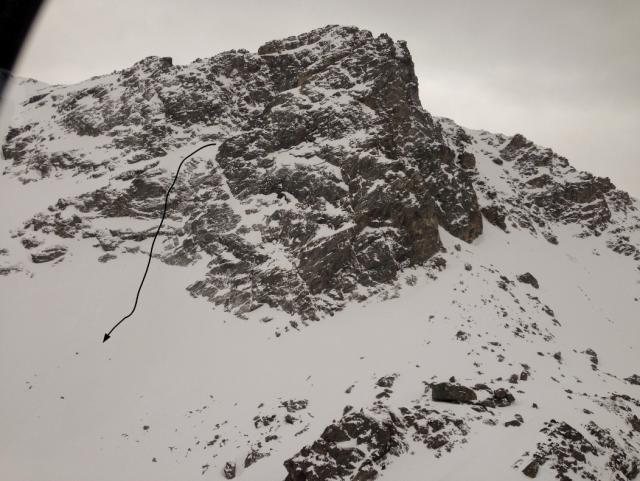
April 11, 2015 view from helicopter. The Gallitan Natioanl Forest Avalanche Center says, "the upper portion of the couloir is mostly out of view but the hanging snowfield can be seen. The avalanche carried the skier over the cliffs."

We will await official word from the Gallitan Avalanche Center when it completes its investigation and update this post with their findings. 

Here is the Avalanche Center's post mortem video, posted Monday, April 13. The finding is the skiers were as careful as they could have been given the inherent danger of the terrain. As can be judged from the video, the chute they were skiing was very narrow and near vertical. 


Avalanche experts with the GNFAC tried to access the site of the slide on Sunday, but were forced to turn back due to gusty winds. Doug Chabot and Mark Staples were able to make it in to Beehive Peak Monday and filmed the video above.

We spoke with forecaster Eric Knoff on Monday morning who said they are working to piece together how this happened to a seasoned skier when avalanche danger was low.
"It did catch us a little off-guard," said Knoff. "It has been such a quiet and fairly benign winter and right when you think you're out of the woods, you can be surprised by an accident like this."
Knoff said although avalanche danger was low, the terrain in the Hanging Garden area where Anderson and his friends were skiing Saturday is really unforgiving.
"There's essentially no room for error," said Knoff. "Unfortunately, they triggered a small slide, that anywhere else wouldn't be a big deal but the terrain magnified the consequences significantly and it ended badly."
Knoff said Anderson and his skiing partners were experienced in the backcountry, had avalanche training and were essentially doing everything right.
"Unfortunately you can make tons of good decisions which can be offset by one bad one," said Knoff. "It's a great reminder that spring is a really fickle time in the mountains and weather and snowpack can change rapidly."
This is the second avalanche fatality in Montana during the 2014-2015 season and the ninth nationwide. Last year, 35 people across the country were killed by avalanches; six of them in Montana.
In May of 2009, Jens Hagen Anderson received his B.S. degree in mechanical engineering from Montana State University. He was a design engineer at Graymatter Research in Bozeman, Montana. May Jens Hagen Anderson rest eternally in peace. Our prayers and sympathies to his family and friends.

Related posts:

Beware the Avalanche.

More Avalanche.

Avalanche Advisories Issued.

Memorial Service for Jens Anderson and Opportunities to Help.

Read the moving obituary and tribute to Jens Anderson published in the Bozeman Chronicle.

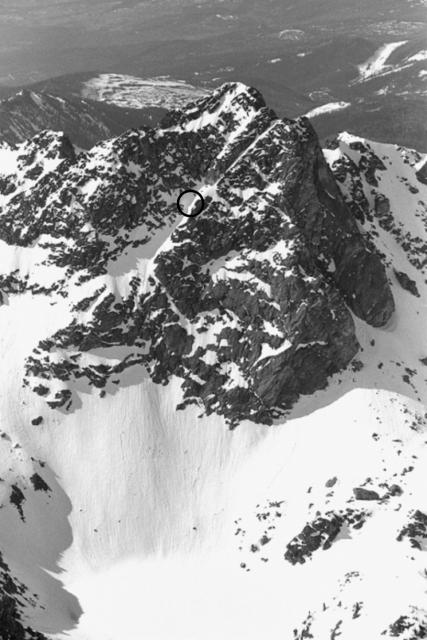
The avalanche was triggered approximately in the location of the black circle. It was one foot deep for about 6 feet and quickly tapered to just a few inches thick on either side. The skier was in the middle of a turn with his skis pointed downhill when it broke. Had he not been in this position, his partners are fairly confident he would have been able to either ski off it or self arrest. Photo, April 12, 2015.


Jens Hagen Anderson skiing a back country couloir, January, 2015.